
Trading Volatility Indices can feel like riding a roller coaster Volatility Indices-thrilling, unpredictable, and sometimes nerve-wracking. That’s why having a solid game plan is key trading strategies. Stop-loss (SL) and take-profit (TP) orders help you stay in control by setting clear exit points for your trades, whether the market moves in your favour or not.
What are stop-loss and take-profit orders?
Imagine you’re trading a Volatility Index. You could sit there watching every price move and hoping for the best, but that’s a stressful (and risky) way to trade. Instead, SL and TP orders do the heavy lifting for you by locking in profits and limiting losses automatically:
- Take profit (TP): This is your profit target. You pick a price where you’d be happy to cash out, and once the market reaches that level, your trade closes, securing your profit.
- Stop loss (SL): This is your safety cushion. You set a price where, if the market turns against you, your trade automatically closes to keep your losses in check.
Let’s break it down with an example. Say you buy Volatility 50 at $271 and set a TP at $280. If the market reaches $280, your trade closes, locking in a $9 profit. At the same time, if you set an SL at $266, your trade will close there, keeping your loss to just $5.
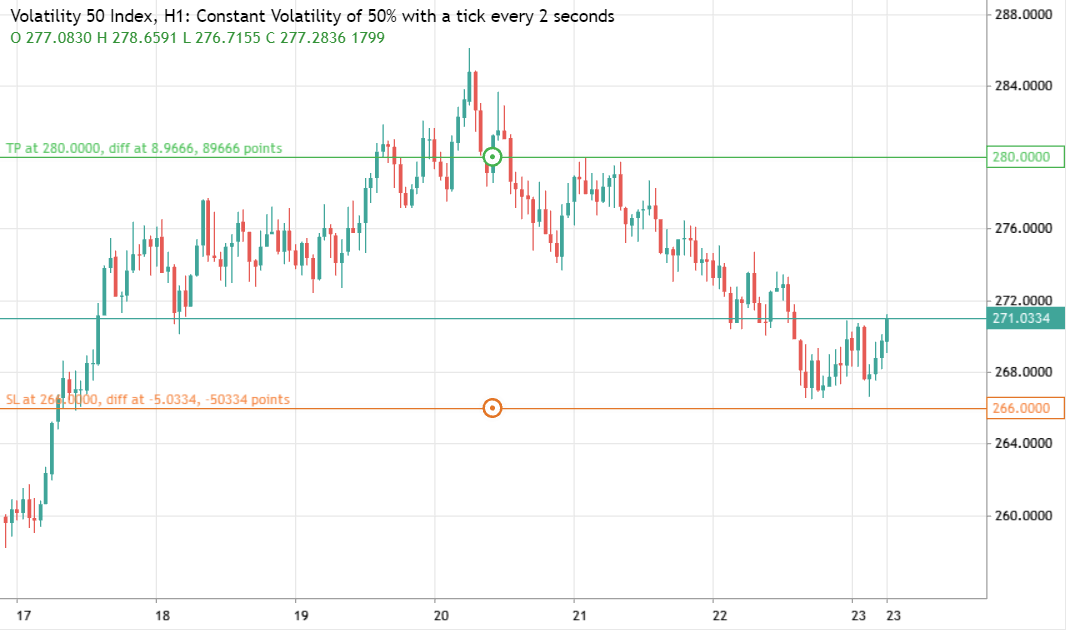
Finding the right balance: The risk-reward ratio
To place your SL and TP wisely, traders use the risk-reward ratio. It’s a simple yet powerful formula:
Risk-reward ratio = Potential profit / Potential loss
In our example:
- Potential profit = $9
- Potential loss = $5
- Risk-reward ratio = 1.8 (for every $1 risked, you could make $1.80)
A higher risk-reward ratio can mean bigger potential wins, but it’s all about finding the right balance based on market conditions and your risk appetite.
Why SL and TP orders matter
Using both SL and TP orders isn’t just about guessing your way through trades. It’s about making smart, strategic choices to protect your money and maximise your gains.
Ready to test your strategy? Practise risk-free with a demo account and see how well you can handle market swings.
Викторина
Что происходит, когда срабатывает ваш ордер Stop-Loss?
Часто задаваемые вопросы




.png)