Operar em Índices de Volatilidade pode parecer uma montanha-russa Índices de Volatilidade - emocionante, imprevisível e, por vezes, stressante. É por isso que ter um plano sólido é fundamental estratégias de trading. As ordens de stop-loss (SL) e take-profit (TP) ajudam-te a manter o controlo ao definir pontos de saída claros para as tuas negociações, quer o mercado se mova a teu favor ou não.
O que são ordens de stop-loss e take-profit?
Imagina que estás a negociar um Índice de Volatilidade. Poderias ficar sentado a observar cada movimento de preço e a esperar pelo melhor, mas essa é uma forma stressante (e arriscada) de negociar. Em vez disso, as ordens SL e TP fazem o trabalho pesado por ti, garantindo lucros e limitando perdas automaticamente:
- Take profit (TP): Este é o teu objetivo de lucro. Escolhes um preço no qual ficarias satisfeito em retirar, e quando o mercado atinge esse nível, a tua negociação fecha, garantindo o teu lucro.
Gestão de riscos de volatilidade: ordens de stop-loss e take-profit. - Stop loss (SL): Esta é a sua almofada de segurança. Defines um preço em que, se o mercado se virar contra ti, a tua negociação fecha automaticamente para manter as tuas perdas sob controlo.
Vamos analisar isto com um exemplo. Digamos que compras o Volatility 50 a 271$ e defines um TP a 280$. Se o mercado atingir 280$, a tua negociação fecha, garantindo um lucro de 9$. Ao mesmo tempo, se definires um SL a 266$, a tua negociação irá fechar aí, mantendo a tua perda em apenas 5$.
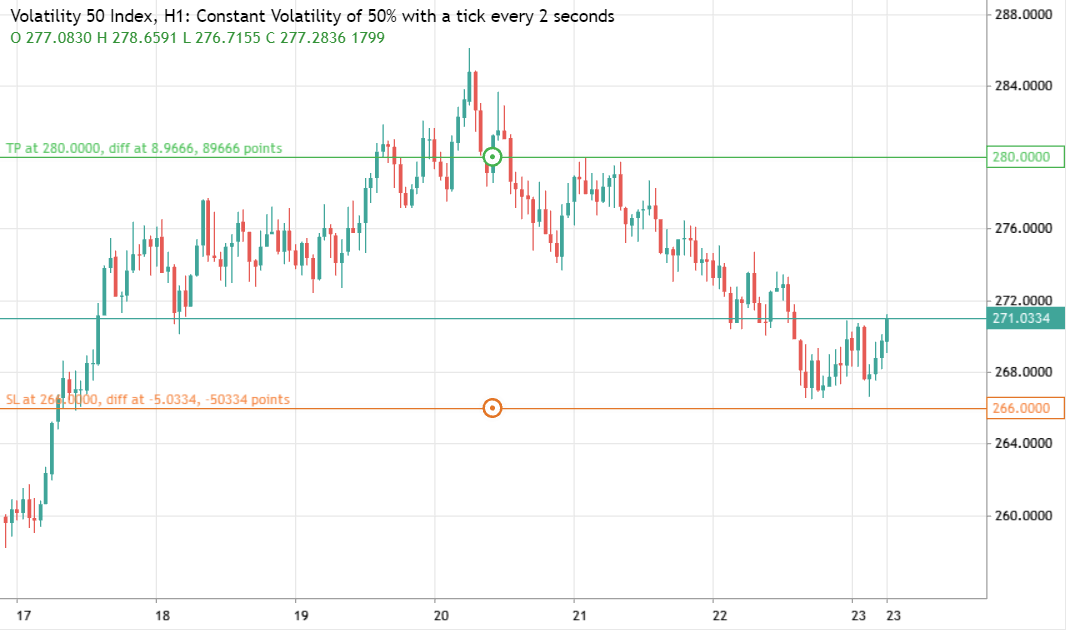
Ao negociar um índice de volatilidade, você pode ficar sentado observando cada movimento de preço, esperando o melhor, mas essa é uma maneira estressante (e arriscada) de operar.
Encontrar o equilíbrio certo: A relação risco-recompensa
Para definir o seu SL e TP de forma sensata, os traders usam o rácio risco-recompensa. É uma fórmula simples, mas poderosa:
Rácio risco-recompensa = Lucro potencial / Perda potencial
No nosso exemplo:
- Lucro potencial = 9$
- Perda potencial = 5$
- Rácio risco-recompensa = 1,8 (por cada 1$ arriscado, poderias ganhar 1,80$)
Um rácio risco-recompensa mais elevado pode significar ganhos potenciais maiores, mas tudo se resume a encontrar o equilíbrio certo com base nas condições do mercado e na tua tolerância ao risco.
Em vez disso, as ordens de stop-loss e take-profit fazem o trabalho difícil por você, protegendo os lucros e minimizando as perdas automaticamente.
Porque é que as ordens SL e TP são importantes
Utilizar tanto as ordens SL como TP não é apenas uma questão de adivinhar o caminho nas negociações. Trata-se de fazer escolhas inteligentes e estratégicas para proteger o teu dinheiro e maximizar os teus ganhos.
Pronto para testar a tua estratégia? Pratique sem risco com uma conta de demonstração e veja como consegue lidar com as oscilações do mercado.
Questionário
O que acontece quando a sua ordem Stop-Loss é acionada?
Perguntas frequentes