Trader des indices de volatilité peut donner l'impression de faire un tour de montagnes russes Volatility Indices - palpitant, imprévisible et parfois angoissant. C'est pourquoi avoir un plan de trading solide est essentiel stratégies de trading. Les ordres stop-loss (SL) et take-profit (TP) vous aident à garder le contrôle en définissant des points de sortie clairs pour vos trades, que le marché évolue en votre faveur ou non.
Que sont les ordres stop-loss et take-profit ?
Imaginez que vous tradez un indice de volatilité. Vous pourriez rester là à observer chaque mouvement de prix en espérant que tout se passe bien, mais c’est une façon stressante (et risquée) de trader. Au lieu de cela, les ordres SL et TP font le travail pour vous en verrouillant automatiquement les profits et en limitant les pertes :
- Take profit (TP) : C’est votre objectif de profit. Vous choisissez un prix auquel vous seriez heureux de clôturer, et une fois que le marché atteint ce niveau, votre trade se ferme, sécurisant votre gain.
Gestion des risques de volatilité : Ordres de stop-loss et de take-profit - Stop loss (SL) : C’est votre coussin de sécurité. Vous fixez un prix où, si le marché se retourne contre vous, votre trade se ferme automatiquement pour limiter vos pertes.
Le trading des indices de volatilité peut ressembler à une montagne russe - excitant, imprévisible et parfois stressant.
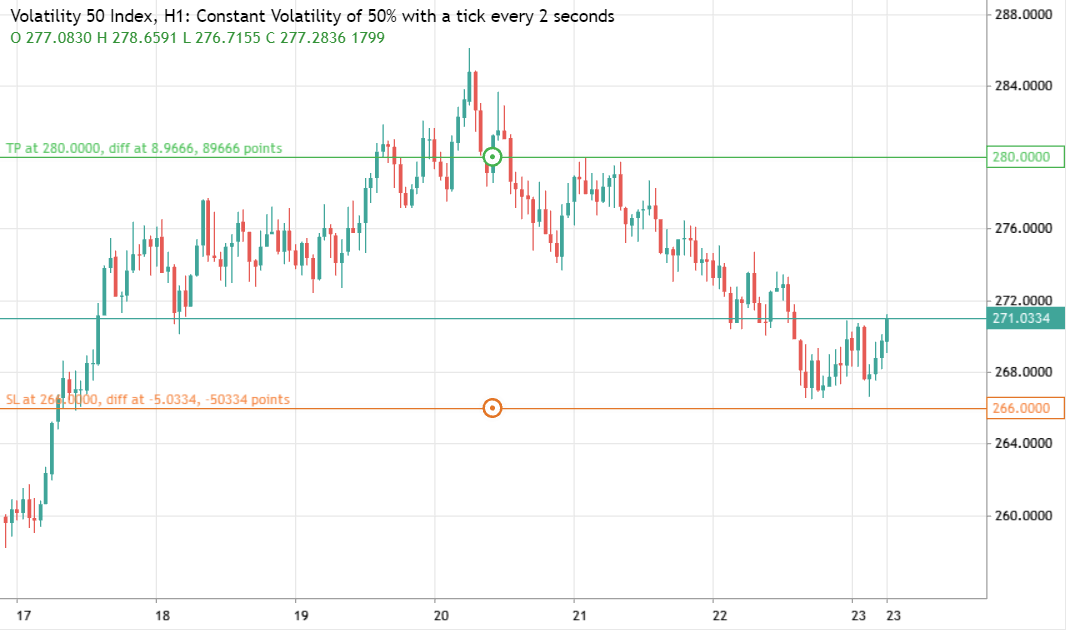
Décomposons cela avec un exemple. Disons que vous achetez Volatility 50 à 271 $ et fixez un TP à 280 $. Si le marché atteint 280 $, votre trade se ferme, verrouillant un profit de 9 $. En même temps, si vous fixez un SL à 266 $, votre trade se fermera à ce niveau, limitant votre perte à seulement 5 $.
Lorsque vous tradez un indice de volatilité, vous pouvez rester là à observer chaque mouvement de prix en espérant le meilleur, mais c'est un moyen stressant (et risqué) de trader.
Trouver le bon équilibre : Le ratio risque-rendement
Pour placer judicieusement vos SL et TP, les traders utilisent le ratio risque-rendement. C’est une formule simple mais puissante :
Ratio risque-rendement = Profit potentiel / Perte potentielle
Dans notre exemple :
- Profit potentiel = 9 $
- Perte potentielle = 5 $
- Ratio risque-rendement = 1,8 (pour chaque dollar risqué, vous pourriez gagner 1,80 $)
Un ratio risque-rendement plus élevé peut signifier des gains potentiels plus importants, mais tout est une question de trouver le bon équilibre en fonction des conditions du marché et de votre appétit pour le risque.
Au lieu de cela, les ordres de stop-loss et de take-profit font le travail difficile à votre place en sécurisant automatiquement les profits et en réduisant les pertes.
Pourquoi les ordres SL et TP sont importants
Utiliser à la fois les ordres SL et TP ne consiste pas à deviner vos trades. Il s’agit de faire des choix intelligents et stratégiques pour protéger votre argent et maximiser vos gains.
Prêt à tester votre stratégie ? Entraînez-vous sans risque avec un compte démo et voyez à quel point vous pouvez gérer les fluctuations du marché.
Quiz
Que se passe-t-il lorsque votre ordre Stop-Loss est déclenché ?
FAQ