The Crash Boom Flip (Flip) Index that fits your trading style depends on how you like to trade. If you prefer frequent events and quick reactions, Flip 150 or Flip 300 suit you better; if you prefer longer trends with fewer but larger interruptions, Flip 500 or Flip 1000 are the better fit. The rest of this article explains why, and gives you a framework for deciding with more confidence.
All four Flip Indices work on the same underlying mechanic. Each one alternates between two phases: a Crash phase, where the price climbs upwards gradually while carrying the risk of a sudden drop, and a Boom phase, where the price declines downwards gradually while carrying the risk of a sudden spike upwards. Every large move is a potential turning point between these two phases; some flip the phase, others are absorbed and the current phase simply continues. That mechanic is identical across all four variants. What changes between them is how often a large move arrives, and how large it tends to be when it does.

If you're catching up on the basics, this is worth reading alongside the announcement of when Flip Indices first launched on Deriv.
Faster-paced: Flip 150 and Flip 300
Flip 150 and Flip 300 are built around shorter average intervals between large moves. On Flip 150, a large move arrives on average once every 150 ticks; on Flip 300, once every 300 ticks. In practical terms, this means the phases, the periods of gradual upwards or downwards drift between large moves, tend to be shorter, and potential turning points come around more frequently.
This pace suits a particular kind of trader. If you enjoy watching a chart closely and reacting to events as they happen, rather than waiting for a longer setup to develop, the faster variants give you more of what you're looking for within a shorter session. Because large moves arrive more often, there's proportionally less time between them to plan your next step, which means the decisions you make around trade size and stop placement carry more weight here. You're managing a higher number of events across the same stretch of time, so the discipline of setting your risk parameters before each trade, rather than reacting after the fact, becomes more important, not less.
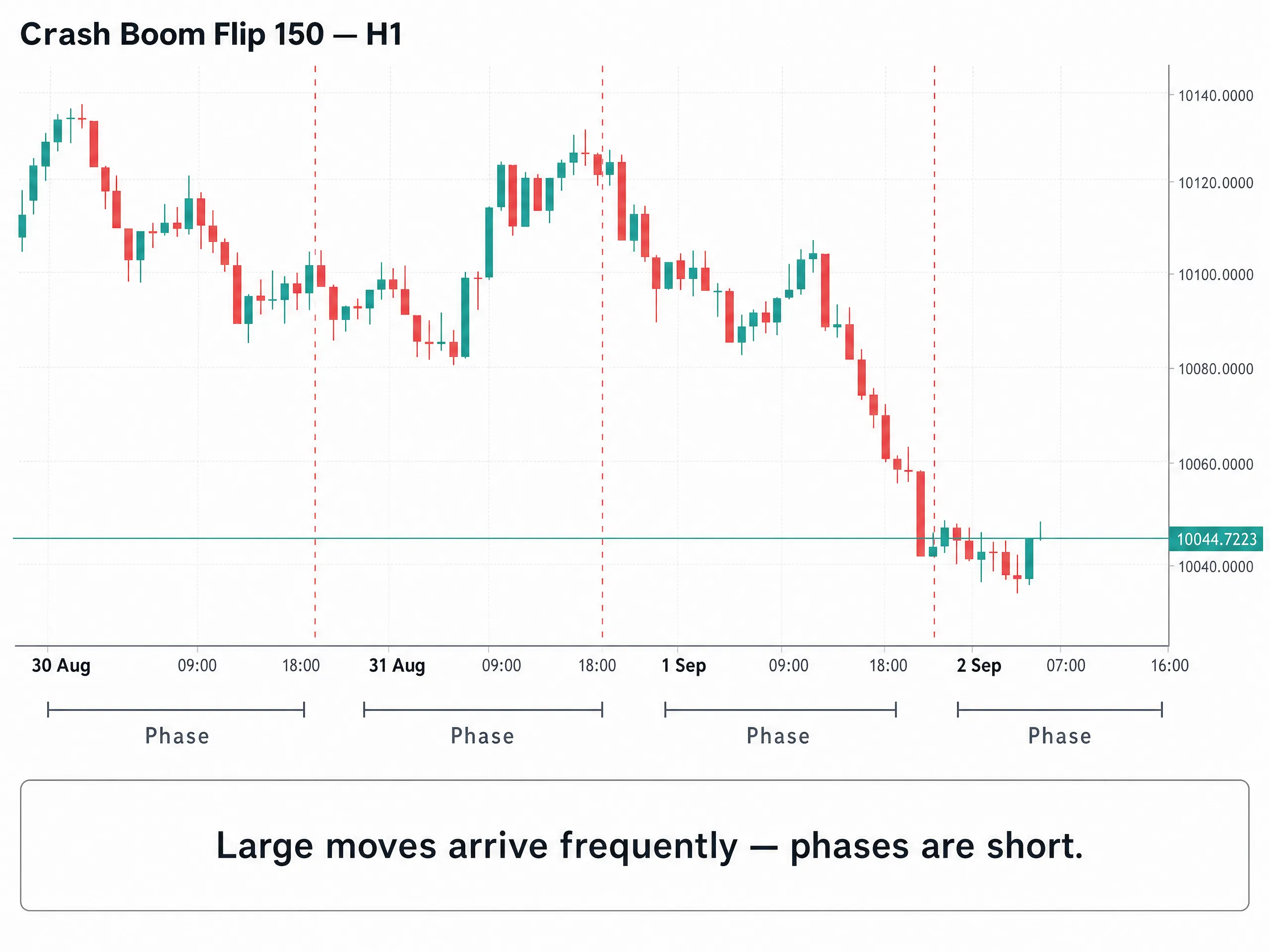
It's also worth noting that "more frequent" does not mean "more predictable." Every large move on Flip 150 or Flip 300 is still an independent event: whether it moves upwards or downwards, and whether it flips the current phase, is decided in the same way it would be on any other Flip variant. The higher frequency simply means you'll encounter that unpredictability more often per session, not that a pattern eventually surfaces if you watch closely enough.
Bigger picture: Flip 500 and Flip 1000
Flip 500 and Flip 1000 sit at the other end of the spectrum. On Flip 500, a large move arrives on average once every 500 ticks; on Flip 1000, once every 1,000 ticks. With fewer large moves occurring across the same stretch of time, each phase has more room to run. The gradual drift, upwards in the Crash phase or downwards in the Boom phase, has a longer stretch of ticks in which to establish a clear direction before the next large move interrupts it.
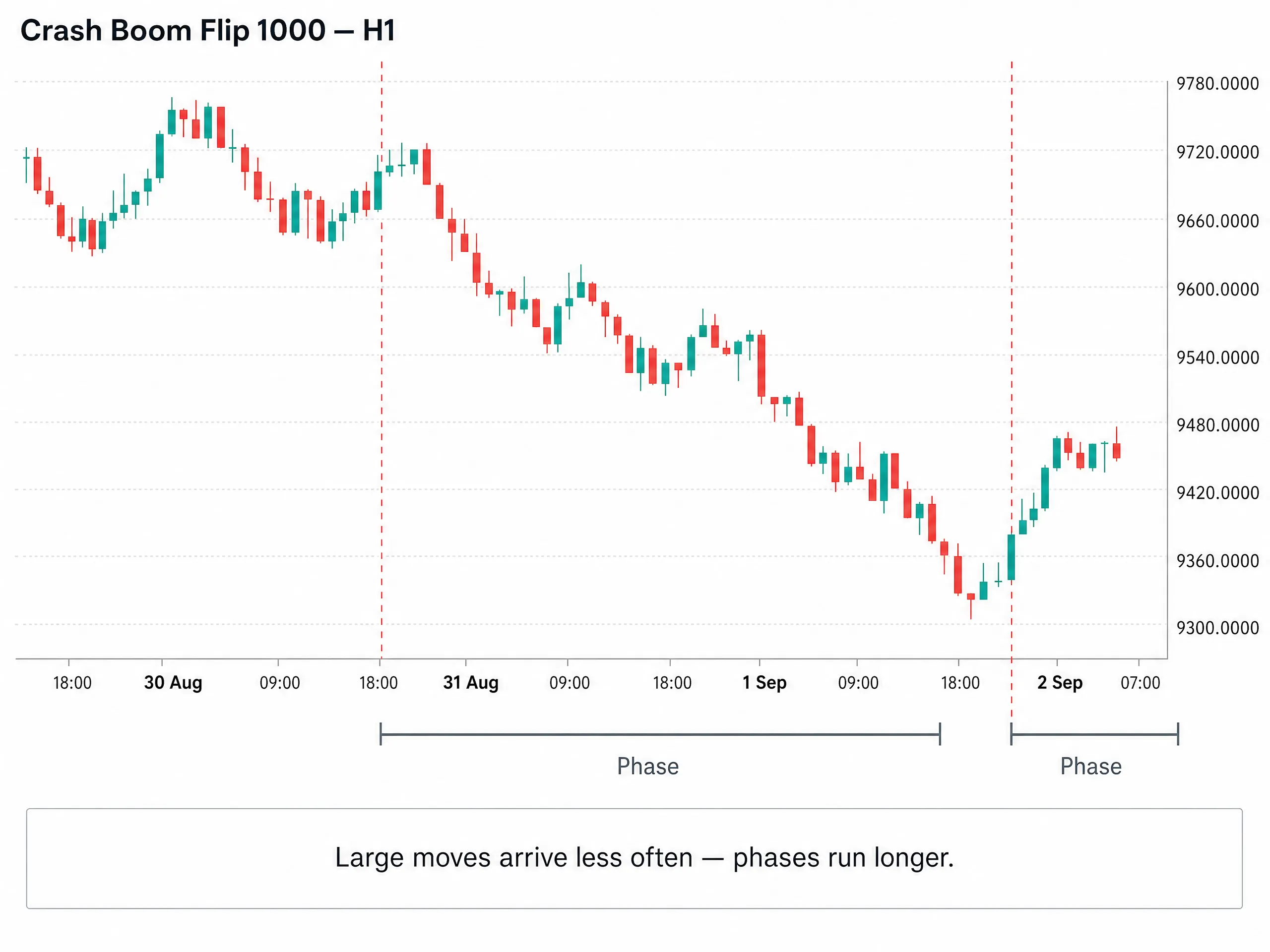
This pace tends to suit traders who prefer to observe a developing trend rather than reacting to frequent events. Because turning points are rarer, there's more time between them to read the direction of the drift and make a considered decision, rather than reacting under time pressure. That said, the trade-off is important to understand: large moves on Flip 500 and Flip 1000 tend to be bigger when they do occur. Rarer does not mean smaller; in fact, the opposite tends to be true. Risk management still matters just as much on these variants; it simply operates on a different timescale, with fewer but potentially more significant events to plan around.
Seeing the difference in practice
The contrast between the two paces becomes clearer with a simple side-by-side comparison.
Imagine watching a Flip 150 Index for one hour. In that time, you might observe roughly 24 large moves on average (60 minutes' worth of ticks divided by the 150-tick interval, assuming a steady tick rate). Some of those moves flip the phase, some are absorbed, and the direction of each one, upwards or downwards, is decided independently. The chart feels active. You're regularly checking in, adjusting your position, and reacting to new information.
Now imagine watching a Flip 1000 Index for the same hour. You might only observe 3 or 4 large moves in that time. Each phase, each stretch of gradual upwards or downwards drift, lasts considerably longer, giving you more time to observe the trend, plan your entry, and set your risk parameters before the next large move arrives. When a large move does occur, it's likely to represent a bigger shift in price than what you'd typically see on the faster variants.
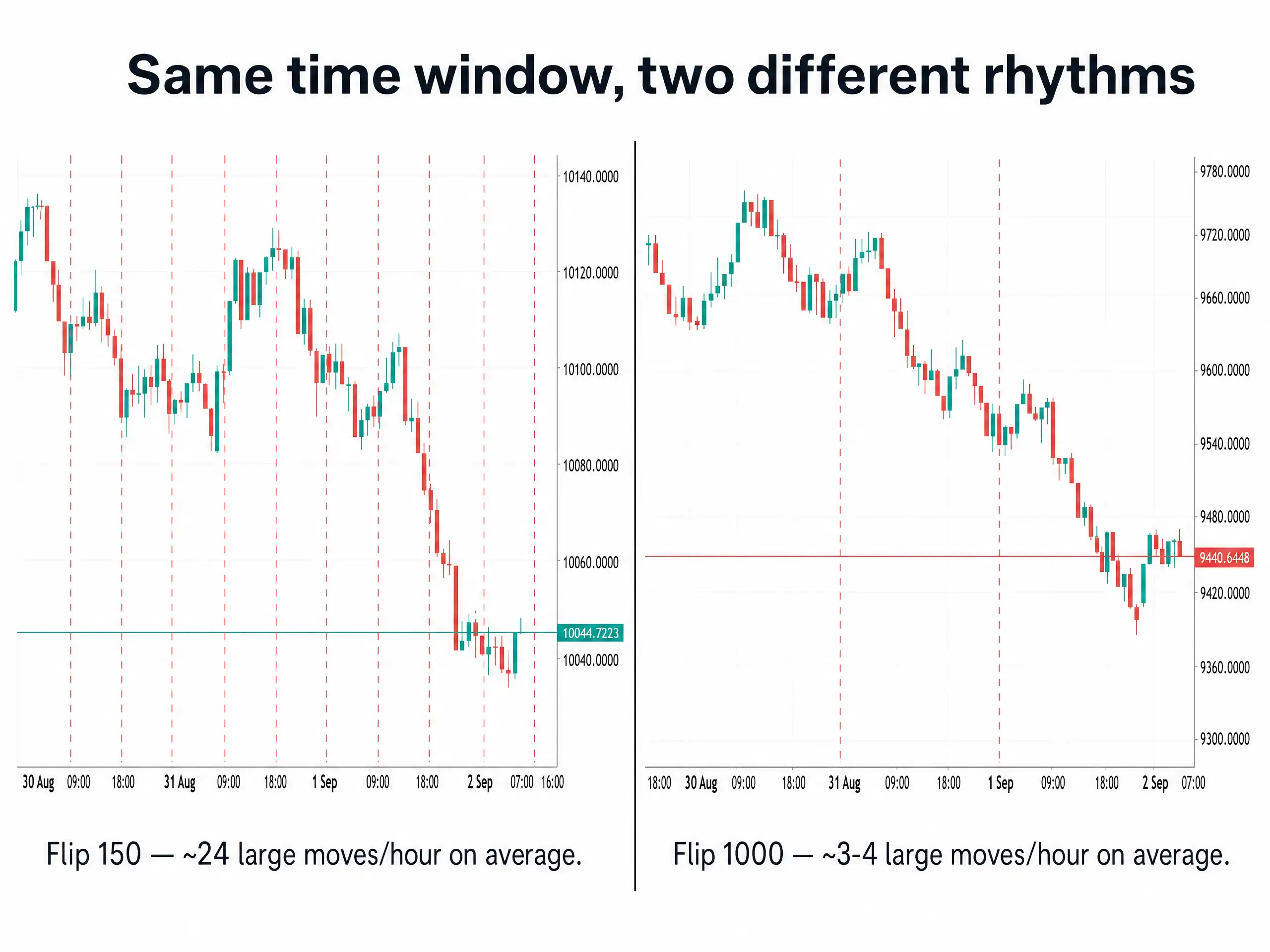
Neither experience is better than the other. They simply demand a different rhythm of attention. The Flip 150 trader is making more decisions, more often, on smaller individual moves. The Flip 1000 trader is making fewer decisions, but each one carries more weight. Recognising which rhythm suits your own attention span and trading habits is a useful first step before choosing a variant.
For a closer look at how this two-phase mechanics works in practice, see our full explainer on what Flip Indices are and how they work.
Matching the index to how you trade
Beyond pace alone, it helps to think about which type of trader you are, since different trading styles naturally lean toward different variants.
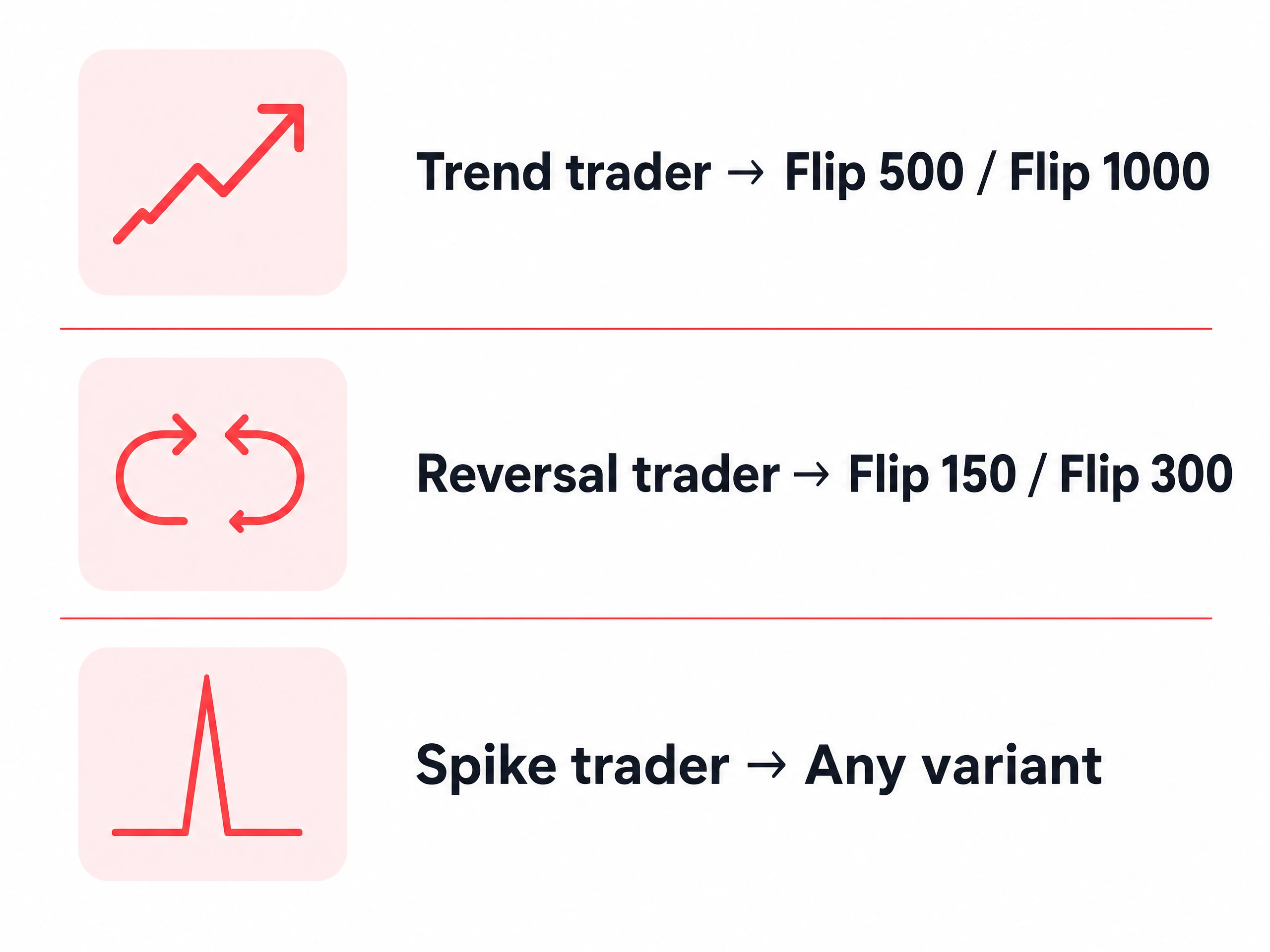
- Trend traders, who look to ride a directional move for as long as it lasts, tend to find Flip 500 or Flip 1000 more suitable. The longer phases on these variants give the gradual drift more room to establish a clear, tradeable direction before the next large move disrupts it. A trend trader on Flip 150 or Flip 300 might find the phases too short to comfortably build and hold a position before the next interruption arrives.
- Reversal traders, who look to trade the turning point itself rather than the trend that follows, tend to find Flip 150 or Flip 300 more suitable. Because large moves, and the potential phase turns they carry, happen more frequently, reversal traders get more opportunities per session to identify and act on a turn. Patience is still required, since not every large move flips the phase, but the sheer frequency of events gives this style of trader more chances to find a genuine turning point.
- Spike traders, who trade the large move itself as an event, regardless of whether it turns out to flip the phase or get absorbed, can find opportunities on any of the four variants, since every Flip Index produces both drops and spikes upwards over time. The choice for a spike trader comes down more to personal preference: whether they'd rather trade smaller, more frequent moves on Flip 150 or Flip 300, or fewer, larger ones on Flip 500 or Flip 1000.
There's no single "right" choice among the four. Each suits a different way of reading the chart and a different trading temperament. The most reliable way to find out which one matches how you trade is to observe each of them directly.
If you're still deciding whether Flip Indices suit your style better than the classic family, this comparison of Flip versus classic Crash and Boom Indices breaks down the difference in more detail.
Test all four on a free demo
The clearest way to understand how these four variants differ is to observe them directly, rather than relying on numbers alone. Open a free Deriv demo account and add all four Flip Indices to your watchlist, whether you're trading on Deriv MT5 or Deriv cTrader. New to either platform? This step-by-step guide to trading Flip Indices on Deriv MT5 and this guide to trading Flip Indices on Deriv cTrader both walk through exactly where to find each symbol and place your first trade.
Watch each one for a similar stretch of time. An hour is often enough to get a feel for the pace. Pay attention to how often large moves occur, how long each phase runs, and whether a given large move flips the phase or gets absorbed.
Trading with virtual funds first lets you build an intuition for the pace and rhythm of each variant before committing real capital, and it's the most reliable way to discover which of the four genuinely fits how you trade, whether compared against each other or against a classic Crash or Boom Index.
Quiz
FAQs


