
Real markets rise, fall, and change their minds. Classic Crash and Boom indices capture the first two moods: a steady grind punctuated by sudden drops or spikes, but each one is committed to a single direction for life. A Crash Index always climbs between its drops; a Boom Index always declines between its spikes. Crash Boom Flip Indices add the third mood: the turn. With the recent launch of Flip Indices, traders now have access to dynamic markets that transition between these phases seamlessly.
What are Crash Boom Flip Indices?
A Crash Boom Flip (Flip) Index alternates between two phases. In its Crash phase, it climbs in small steps while carrying the risk of a sudden drop. In its Boom phase, it declines in small steps while carrying the risk of a sudden spike. On average, one large move arrives every 150, 300, 500 or 1,000 ticks, depending on the variant you choose. Also, any large move can be the moment the index changes character, ending a slow climb and beginning a slow decline, or the other way around.
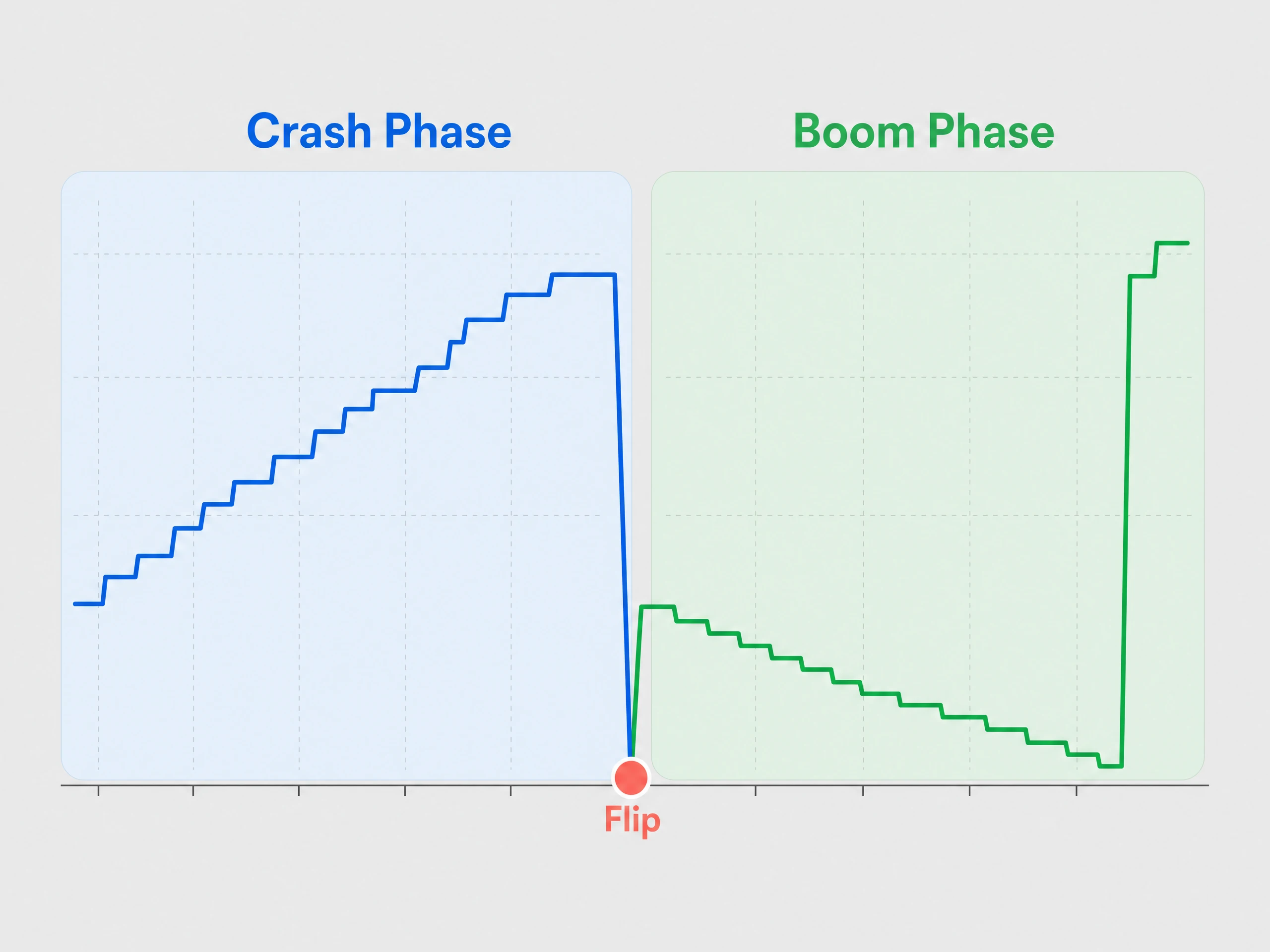
That unpredictability is built in by design. Like all Deriv Synthetic Indices, Flip Indices are available to trade 24/7, driven by a secure random number generator that keeps them unaffected by market hours, news events and real-world liquidity.
How they behave
- Between large moves, the price grinds steadily in the direction of the current phase: up in Crash, down in Boom.
- A large move arrives on average once every N ticks, where N is the number in the index name. An average is not a countdown: large moves cluster and stretch out unpredictably.
.webp)
- Any large move may flip the phase. Some drops end the climb and open a declining phase; others are absorbed and the climb resumes. You can see which happened by whether the grind changes direction.
- Both directions live on one chart. Unlike a classic Crash or Boom Index, the same symbol produces both sudden drops and sudden spikes over time.
The lineup
Flip vs classic Crash and Boom
The table above sets out the mechanics; in practice, it comes down to this: if a classic Crash Index is a market that only ever corrects, a Flip Index is a market with a cycle, which includes accumulation, break, distribution, break. That makes it the more natural home for strategies built around reversals rather than continuation.
What this means for your trading
Trend traders get clearly defined phases to work with, since the grind direction shows which regime is in play. Reversal traders, by contrast, get turning points anchored to visible events instead of ones that arrive silently. Spike traders, meanwhile, no longer have to choose between a Crash and a Boom symbol. One instrument produces both.
Whatever the style, the discipline is the same as for every Synthetic Index: the timing of any individual large move is random. The variant number describes a long-run average, so no counting of ticks can tell you when the next move, or the next turn, will arrive. Position sizing and stop placement matter here exactly as much as they do on classic Crash and Boom.
How to trade Crash Boom Flip Indices
Crash Boom Flip Indices are available as CFDs on Deriv MT5 and Deriv cTrader. If you’re new to the family, a Deriv demo account lets you watch the index rise, fall, and change its mind, and test a strategy with virtual funds before trading for real. You can also learn how to trade them on Deriv MT5.
Quiz
FAQs


