To trade Anthropic (ANT) CFDs on Deriv, open a Deriv account, find the ANT symbol on Deriv MT5, Deriv cTrader or TradingView, and place a buy or sell order.
A CFD (contract for difference) lets you speculate on the ANT price rising or falling without owning the share. This guide explains how an ANT CFD works, how to place a trade, what the key trading conditions are, and which risks to understand before you start.
Anthropic is an AI company whose shares trade on Nasdaq under the ticker ANT.
How to trade ANT CFDs on Deriv
- Choose a platform. From the Deriv dashboard or the CFDs menu, pick Deriv MT5 (Standard or Financial account), Deriv cTrader or TradingView.
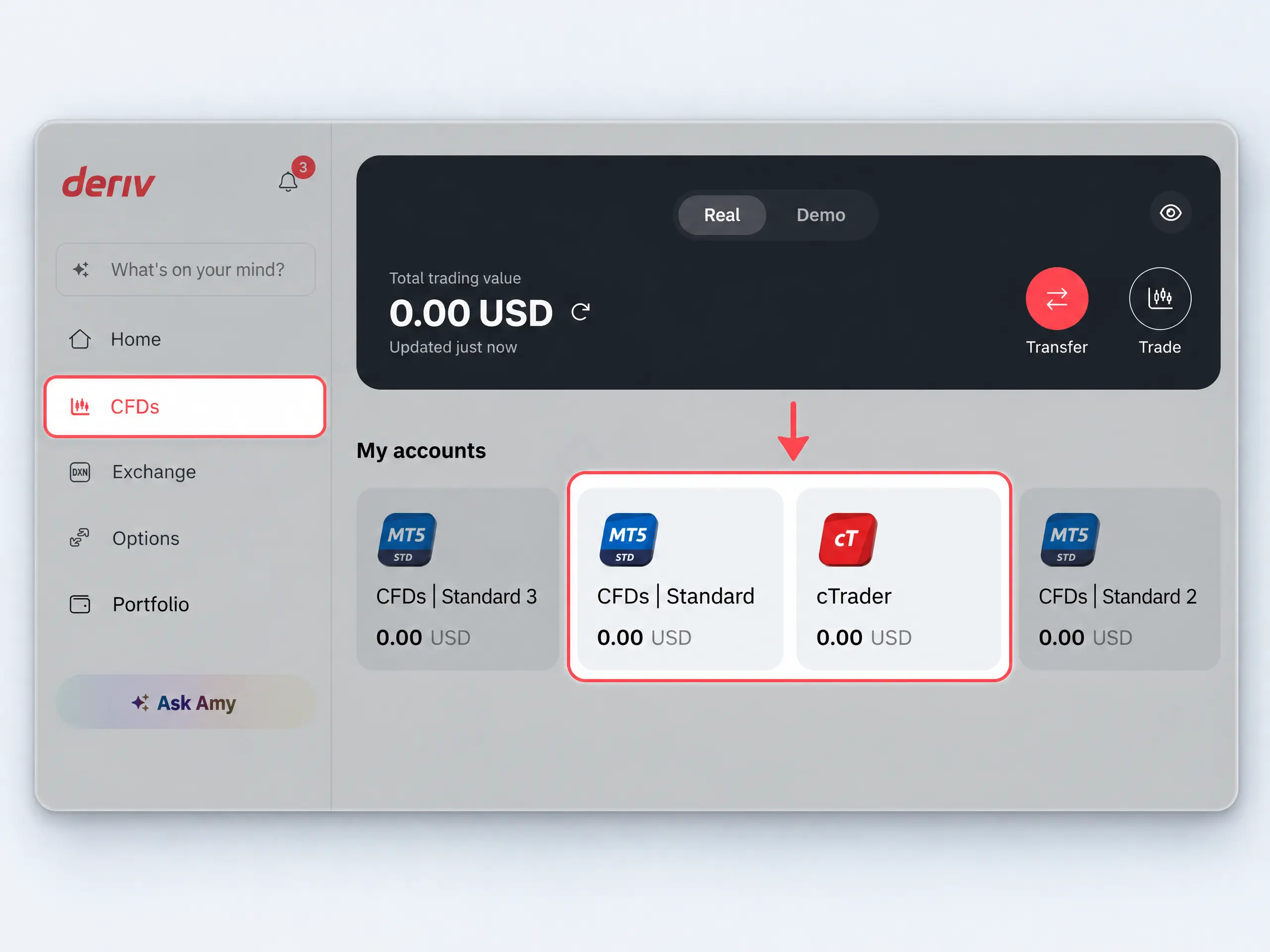
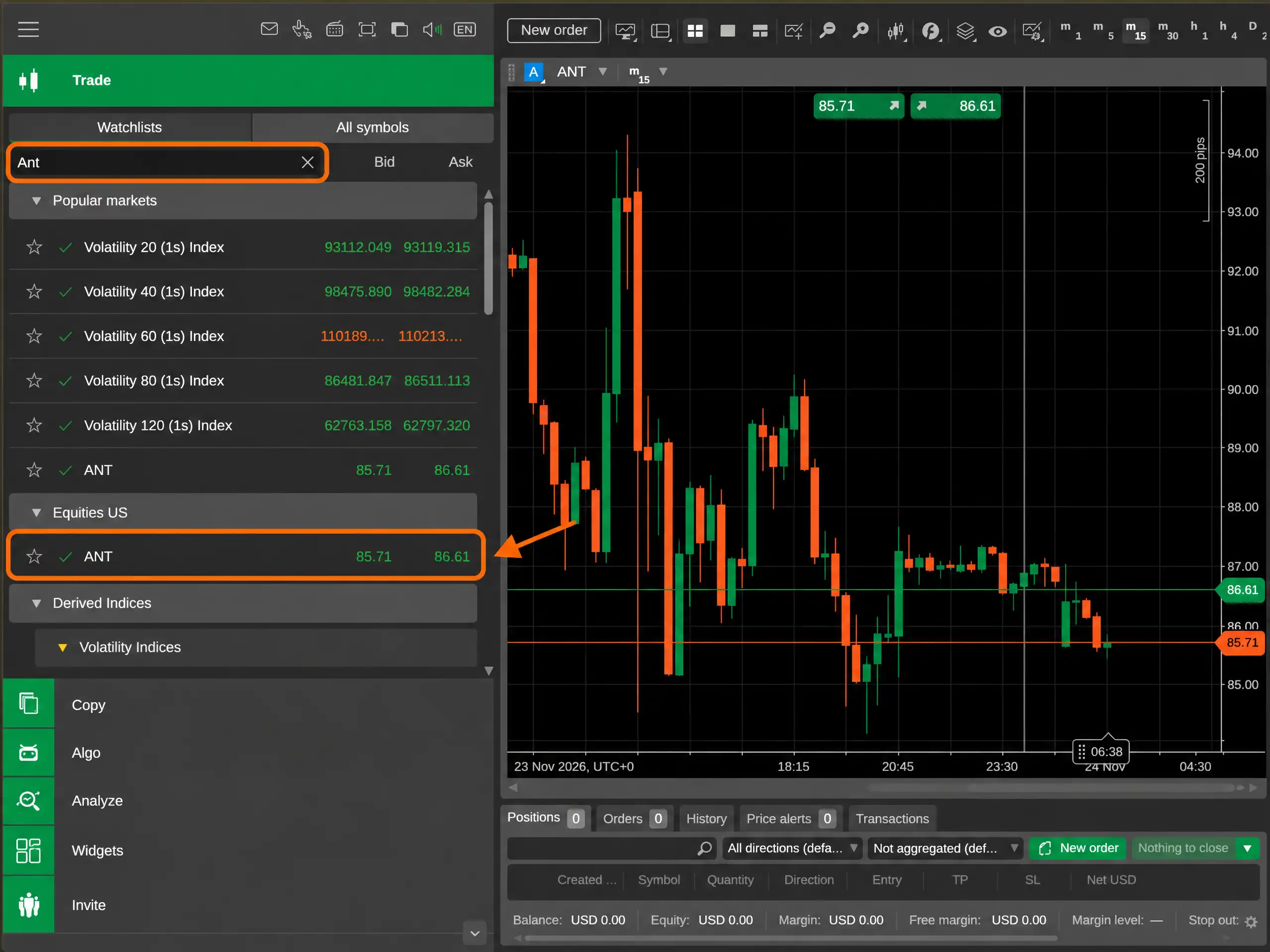
- Find the symbol. Search for ANT.OQ on Deriv MT5, or ANT on Deriv cTrader and TradingView.
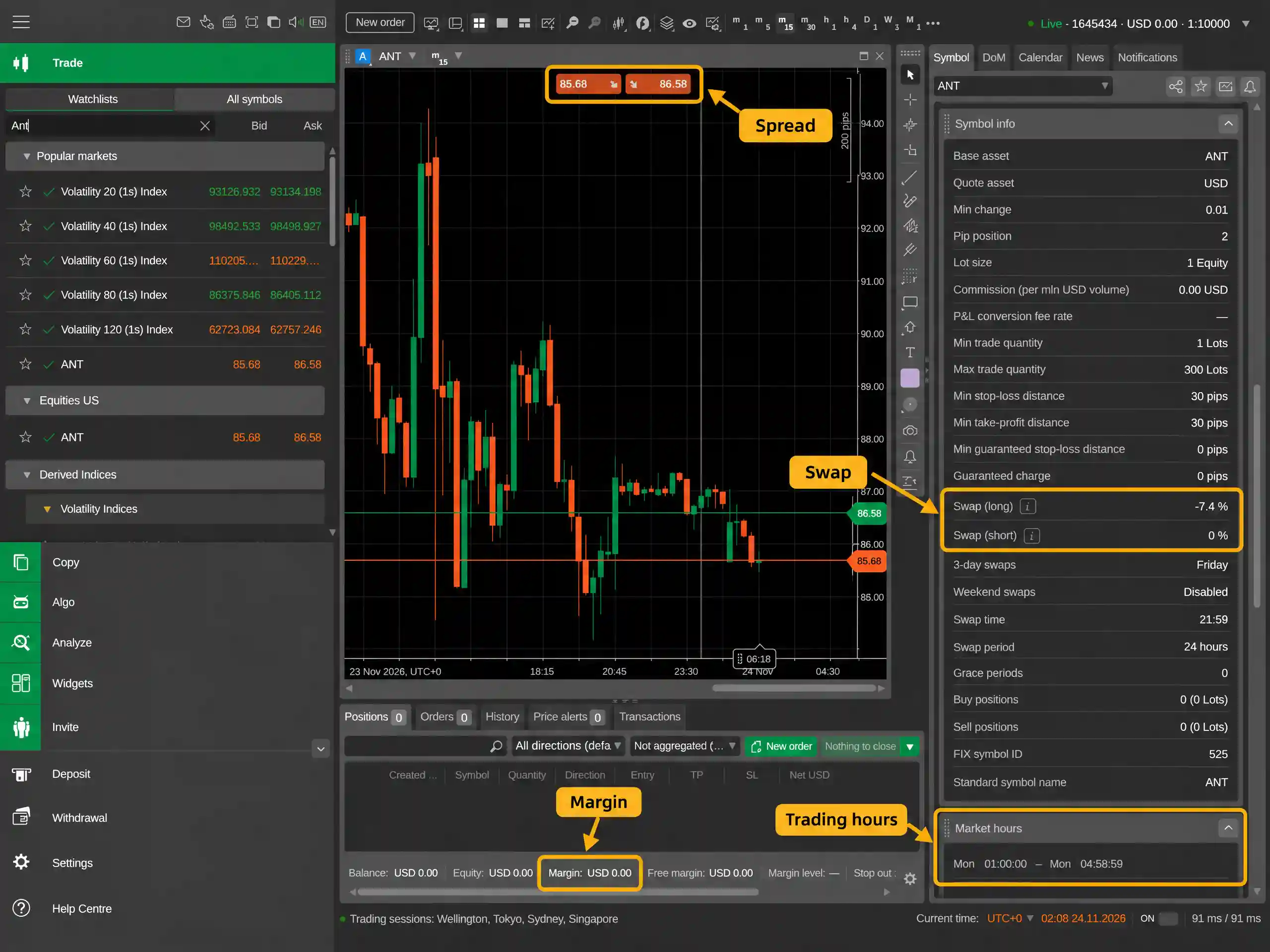
- Check the trading conditions. These include:
- Spread: the gap between the buy price and the sell price. It’s a cost each time you open a trade.
- Margin: the money set aside to open and hold a trade.
- Swap: a fee for holding a position overnight.
- Trading hours.
- Set your order size. The minimum is 1 share, in steps of 1. The maximum is 300 shares per order. Pick a size where the margin and the possible loss stay within your risk limit.
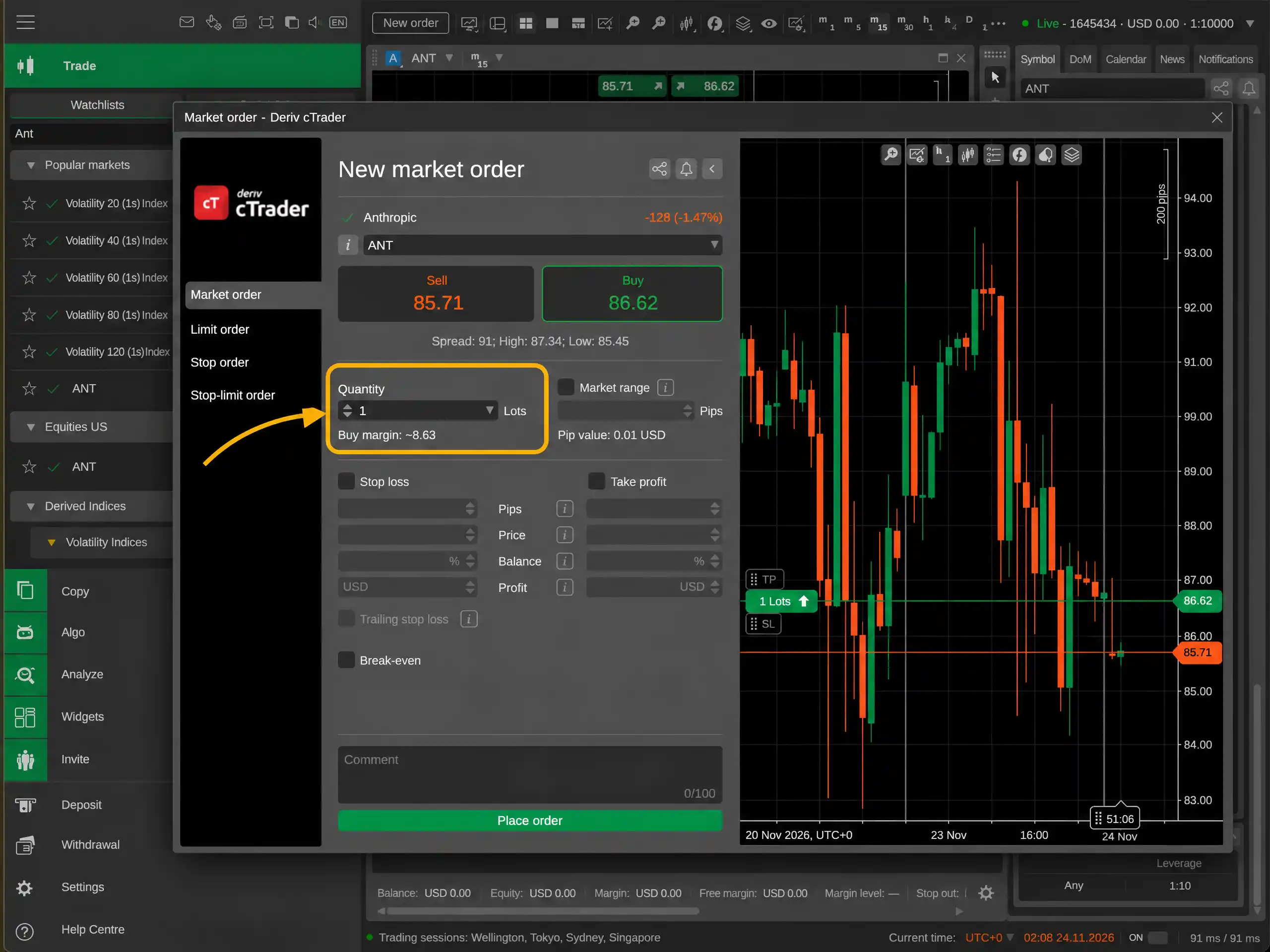
- Add a stop loss. This is an order that closes your trade if the price moves against you by a set amount. In fast markets, it may not fill at the exact price you set.
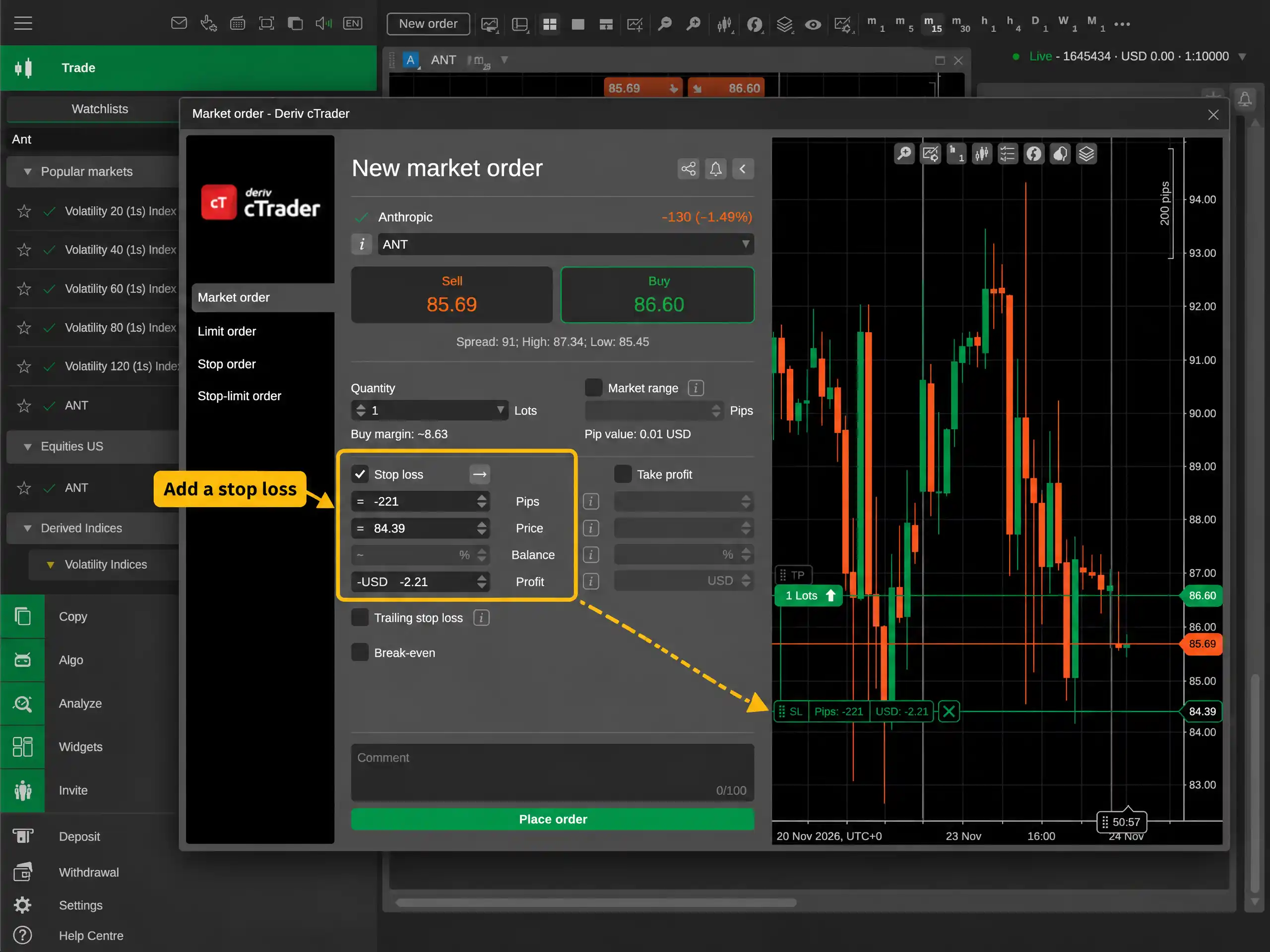
- Place the order and watch it. If you hold a long (buy) position overnight, check for swap charges.
Before you trade with real funds, test your plan. Check how margin, spread and swaps affect a position.
How leverage and margin work with ANT
Leverage lets you open a bigger position with less money. ANT CFDs have 1:10 leverage. This means you put up 10% of the position value as margin.
Here’s a hypothetical example, not a forecast. Say ANT costs $100 per share and you buy 10 shares.
- Position value: 10 × $100 = $1,000
- Margin at 10%: $100
A 10% fall wipes out your whole margin on this trade. Your platform may also close the trade for you if your account reaches the stop-out level. That is the point where the platform closes trades to limit further loss.
Leverage works both ways. It makes your losses bigger, just as it makes your gains bigger. For more detail, read What is leverage in trading?
Risks and trading considerations
- Volatility: Prices can move fast. A share in its first weeks of trading can move more than an older one. The price can also jump from one level to another with no trades in between. This is called a gap. Gaps can happen at the market open and after news.
- Leverage: Your loss is based on the full position value, not just the margin.
- Swap costs: A long position held for days or weeks adds up swap charges. These reduce your result. Short positions have no swap charge. A position held over Friday gets a triple charge.
- Trading hours (GMT):
- Mon to Thu: 01:00 to 22:05, then 22:30 to 23:59
- Fri: 00:00 to 21:59
- Daily break: 22:05 to 22:30, Mon to Thu
- The price may open at a different level from the last close.
- Position size: Before you trade, decide how much of your account you can afford to lose on it. Do not set the size by the profit you hope for.
- No guarantees: Past price moves do not predict future ones.
Quiz
You buy 10 ANT CFDs at $100 each with 1:10 leverage. How much margin do you need?
Which type of position pays a swap charge?
What do you own when you trade an ANT CFD?
FAQs


