Forex trading lets you speculate on currency prices forex trading basics without owning the underlying currencies. Thanks to CFDs (Contracts for Difference), you can trade with leverage, meaning you control a bigger position leverage in trading with less money upfront. It's a powerful feature, but it comes with a cost. Here’s the deal: since you’re technically borrowing money to trade, there’s an interest cost involved. That’s where rollovers come in.
What is a rollover in forex trading?
A rollover, also called a swap fee or overnight interest, is what you pay (or sometimes earn) when you keep a forex trade open overnight. Think of it as the cost of holding onto a borrowed position.
Here’s how it works: every currency pair has its own interest rate. If the currency you buy has a higher interest rate than the one you sell, you might get a little bonus (a credit). But if the one you sell has the higher rate, you’ll have to pay a fee.
How are forex rollover fees calculated?
Swap fees depend on:
- Your trade size (volume)
- The contract size (usually 100,000 for forex)
- The point value of the currency pair
- The interest rate difference (swap rate)
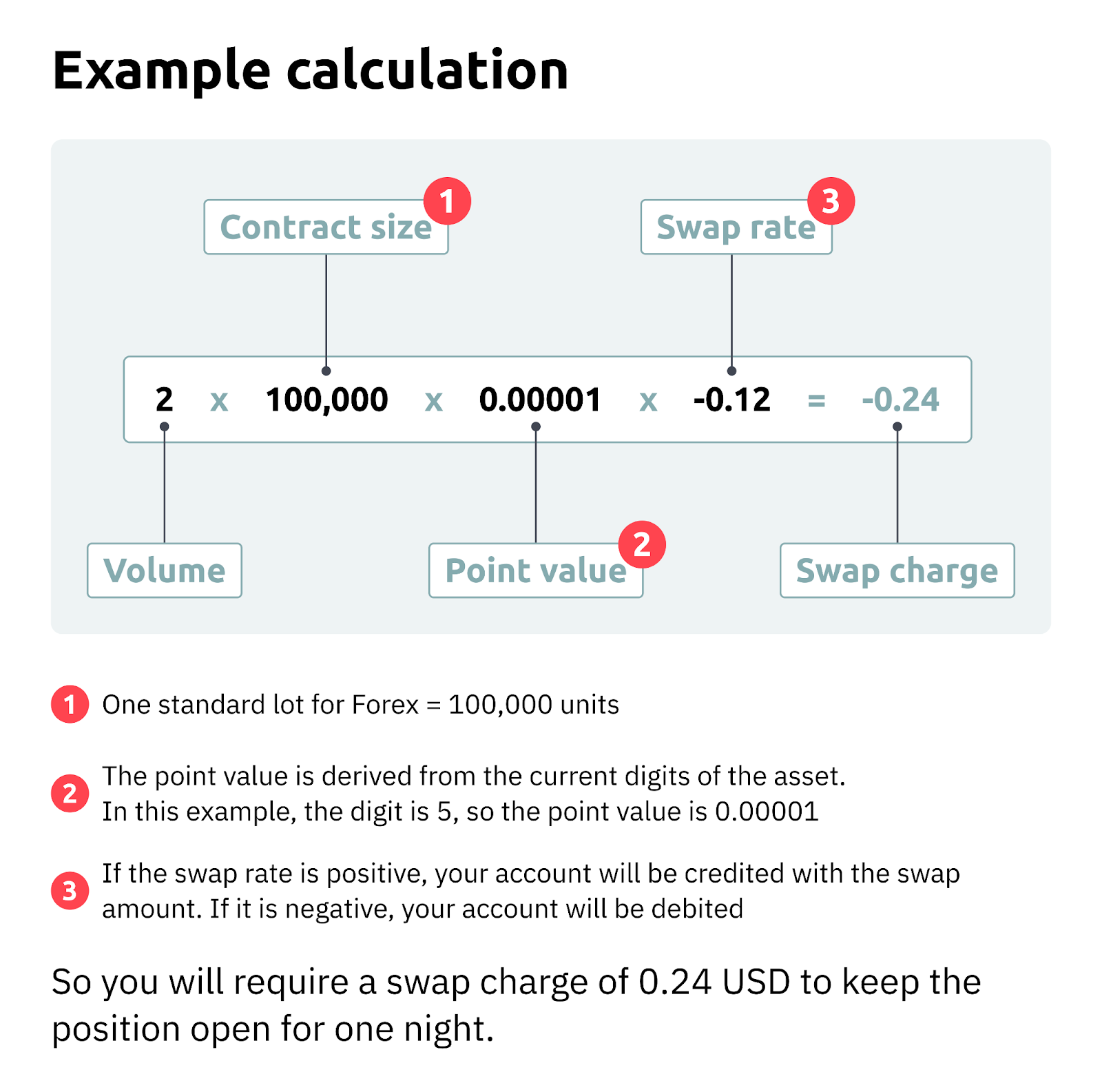
Swap charge formula: volume × contract size × point value × swap rate
Example time! Let’s say you hold two lots of EUR/USD with a swap rate of -0.12 overnight. You’ll be charged 0.24 USD. Here's the important bit—on Wednesdays, brokers triple the fee to account for the weekend, so instead of 0.24 USD, you’d be looking at 0.72 USD.
Want to check the exact swap rates for your favorite forex pairs? Check Deriv's trading specifications page.
How to manage forex rollover fees like a pro
Some traders actually use rollover fees to their advantage. How? By trading currency pairs with positive interest rate differentials (like USD/JPY), they earn swap fees instead of paying them. But before you get too excited, keep in mind that these trades can be crowded and volatile.
If you’d rather avoid rollover fees altogether, here’s a simple trick: close your trades before the daily rollover time. And definitely watch out for Wednesdays when the fee triples.
Want to trade without rollover fees?
Deriv offers swap-free MT5 accounts, which follow Islamic finance principles-meaning no interest charges at all.
Quiz
Qu'est-ce qui influence principalement les frais de report sur le forex ?
FAQ