
High Frequency Volatility (HFV) Indices generate a continuous stream of price updates at a fixed rate of two ticks per second. This creates a fast-moving market where trends, breakouts, and reversals can develop within seconds rather than minutes or hours.
Because trading opportunities emerge and resolve quickly, many traders use short-term approaches when participating in these markets. The rapid pace of HFV Indices creates a trading environment that differs significantly from traditional markets, where activity may slow during certain periods or change in response to economic events.
This article explores how high-frequency price updates influence market behaviour, why they often align with short-term trading strategies, and what traders should consider when participating in fast-moving markets.
Key takeaways
- High Frequency Volatility (HFV) Indices update twice every second, creating a continuous stream of market data without the gaps often seen in traditional markets.
- The higher tick frequency causes trends and price patterns to form more quickly, which may require traders to adapt their analysis and tools.
- Because opportunities develop and resolve rapidly, many traders favour shorter holding periods on HFV Indices.
- Fast-moving markets can also generate more false signals, making discipline and risk management essential.
How do tick frequency and market behaviour relate?
Tick frequency refers to how often the market price changes over a given period. The more frequently prices update, the faster market conditions can evolve.
HFV Indices produce:
- 2 ticks per second
- 120 ticks per minute
- 7,200 ticks per hour

This higher update rate gives traders a much denser stream of price information than they would typically see in many traditional markets.
More ticks do not necessarily mean larger price movements. Instead, they mean that price changes occur more frequently, allowing market patterns to develop in a shorter period.
For example, a short-term trend that might take several minutes to emerge in another market could develop within seconds on an HFV index.
This compressed timeframe is one of the defining characteristics of high-frequency markets.
How do higher tick speeds change market structure?
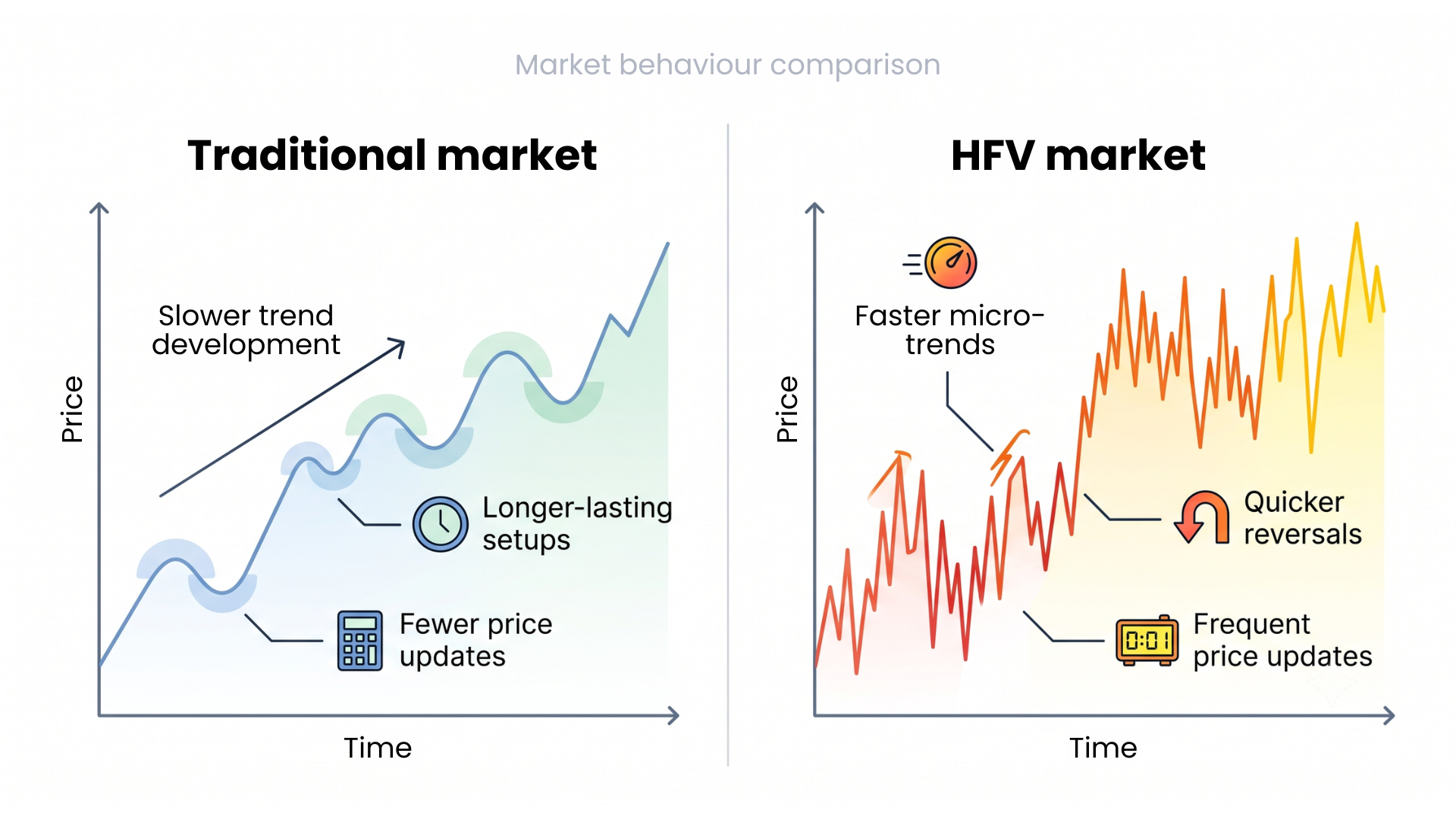
When prices update more frequently, market behaviour changes as well. Trends can emerge more quickly, key levels may be tested repeatedly, and technical signals can become outdated sooner.
Some indicators may appear to lag because market conditions can change faster than the indicators themselves can react.
Micro-trends form more quickly
A micro-trend is a short directional movement that may last only seconds or minutes. On HFV Indices, these trends can develop and complete rapidly, creating opportunities for traders who specialise in short-term execution.
Support and resistance levels are tested more often
Key price levels may be reached and retested multiple times within a short period. This can generate more trading opportunities but may also produce more failed breakouts and false signals.
Technical setups have a shorter lifespan
A chart pattern or entry signal can become invalid much more quickly than it would in slower-moving markets. Traders often need to make decisions promptly once their conditions are met.
How do HFV Indices relate to short-term trading?
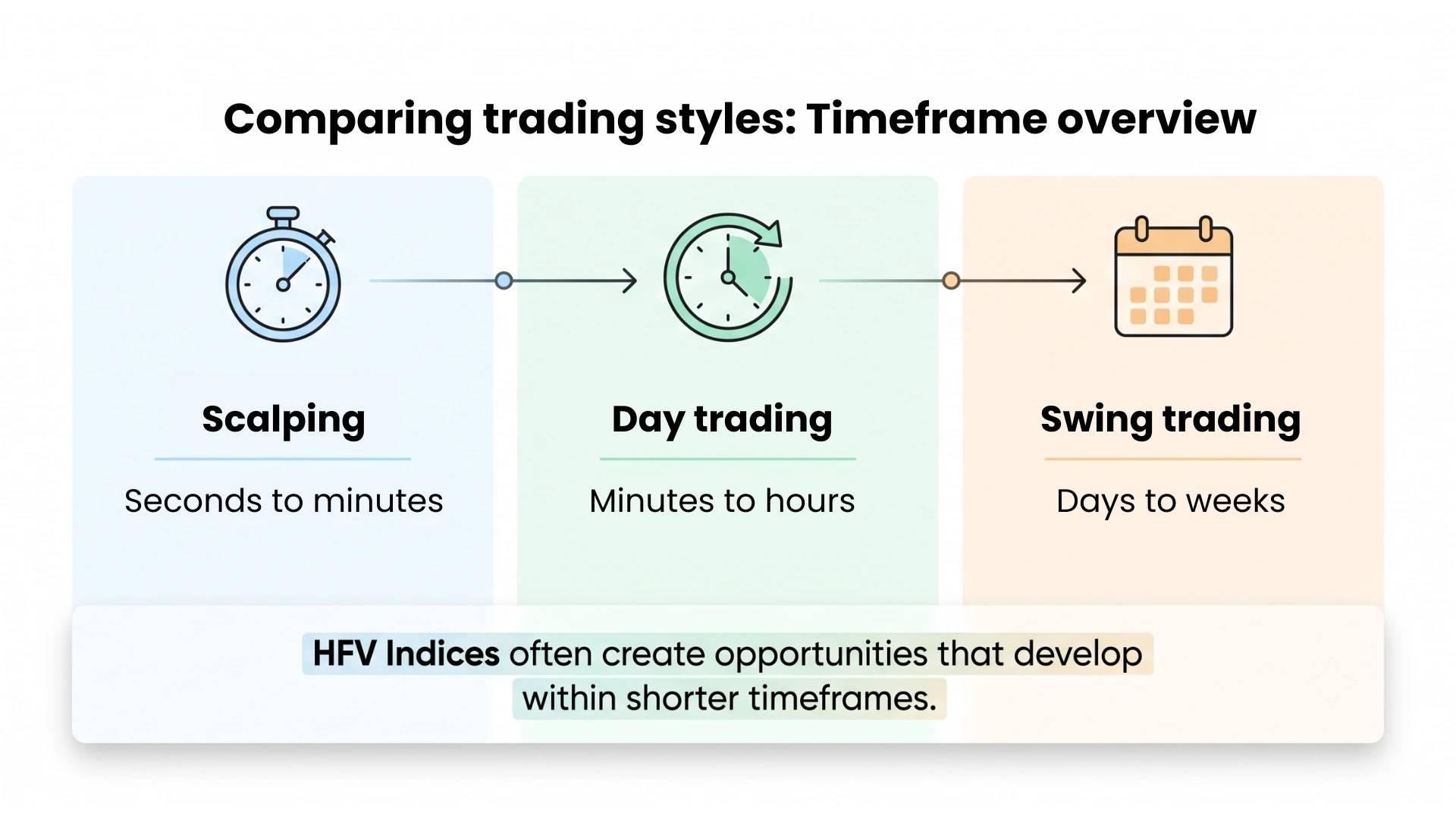
Short-term strategies are frequently applied to HFV Indices because the frequent price movement generates regular opportunities that develop within seconds or minutes. Different trading styles operate on different time horizons.
Because HFV Indices produce frequent short-term movements, many traders use strategies that aim at capturing smaller price changes. A key benefit of these indices is that they’re not affected by macroeconomic news. In traditional markets, big news events can cause sudden price changes. This often leads to slippage, where prices jump past your stop-loss levels, potentially resulting in larger losses than you planned.
HFV Indices, unlike traditional markets, are not influenced by global news. Because prices update steadily without gaps, you may find it easier to apply your technical strategies consistently. This steady movement is why many traders focus on shorter timeframes when using these indices.
Four characteristics make HFV Indices particularly appealing to short-term traders:
- Continuous price movement creates regular opportunities.
- Frequent retracements can generate multiple entry points.
- Momentum bursts often develop and complete quickly.
- Traders spend less time waiting for setups to form.
This doesn't mean that longer-term strategies are impossible. However, many traders find that shorter holding periods are better suited to the pace and structure of these markets.
Why may technical indicators need adjustment?
In fast-moving markets, some technical indicators may need to be adjusted so they can respond more effectively to rapid price changes. Technical indicators are mathematical calculations based on historical price data. In markets that update rapidly, some indicators may react more slowly than the market itself.
This delay between the market's movement and the indicator's response is known as lag.
An indicator that works effectively in a slower market may provide signals too late in a high-frequency environment because the underlying market conditions have already changed.
For this reason, some traders experiment with shorter settings that place greater emphasis on recent price data.
For example:
Indicator settings should always be tested carefully. Faster settings may react more quickly, but they can also generate more false signals.
How can traders distinguish between signal quantity and signal quality?
One of the biggest challenges in high-frequency markets is that more information doesn't always lead to better decisions. Because prices update rapidly, traders are exposed to more chart patterns, breakouts, and indicator signals. The challenge is deciding which signals are meaningful and which are simply market noise. However, more information doesn’t automatically lead to better decisions.
In fact, the opposite can occur. A large number of signals can encourage traders to enter too many positions or react impulsively to every price movement.
Many experienced traders focus on identifying a small number of high-quality setups rather than trying to participate in every market move.

Why do execution and risk management become more important?
In high-frequency markets, even small mistakes can have a larger impact because conditions change so quickly. This makes execution and risk management just as important as market analysis.
Delayed decision-making
A few seconds of hesitation can significantly change an entry or exit price, leading to unfavorable execution. When trading at this speed, this price difference can lower your profits and make your carefully planned trade fail.
Position sizing errors
Even a few seconds of hesitation can lead to a different entry or exit price. In a fast-moving market, small price changes can quickly reduce potential profits or invalidate a carefully planned trade setup.
Emotional decision-making
The speed of the market can tempt traders to move stop-loss levels or take impulsive, unanalysed trades. Maintaining emotional objectivity is essential for sticking to a strategy when price action moves against a position.
To mitigate these risks, many successful traders establish and follow a structured set of rules before ever opening a position:
- Maximum risk per trade
- Pre-defined stop-loss levels
- Entry and exit conditions
- Daily loss limits
Having a structured process can help maintain discipline when markets move quickly.
What are the psychological demands of high-speed trading?
Fast-moving markets place unique demands on a trader's decision-making process. Some common challenges include:
Fear of missing out
Because HFV Indices move so quickly, it can feel like every price movement is an opportunity. This can create a fear of missing out (FOMO) and tempt traders to jump into trades too early or ignore their trading plans. A good way to manage this is to follow a clear checklist before entering a trade and remember that there will always be other opportunities in the market.
Overtrading
Because HFV Indices update twice every second, it can feel like there is always another trading opportunity. This may tempt traders to ignore their plans and take "just one more trade," focusing on the number of trades instead of the quality of their setups. To avoid this, consider following a clear trading plan and only entering trades that meet your predefined conditions. Without a set of rules to guide your decisions, it's easy to take low-quality trades that can gradually lead to losses.
Revenge trading
Constant price updates and frequent signals can be mentally tiring. Over time, this can lead to decision fatigue, making it harder to stay focused, follow your risk rules, and make good trading decisions. To avoid mental exhaustion, some traders prefer to trade in shorter, focused sessions and take regular breaks.
Cognitive overload
Processing constant high-volume data and rapid signals places immense strain on the brain, leading to decision fatigue and degraded judgment. When fatigued, risk discipline wavers and reflexes slow. To maintain your analytical edge, limit trading to focused, 60-minute sessions. Some traders choose to trade in shorter, focused sessions and take regular breaks to avoid mental fatigue.
Many successful short-term traders focus as much on managing their emotions as they do on analysing charts.
How should traders practice in a high-frequency environment?
Practising on a demo account can help you get used to the speed of HFV markets before trading with real money. You can test your strategy, risk rules, and trading plan in a simulated environment to see how they perform. Because HFV Indices move constantly, having a clear and consistent approach can help you make better decisions.
Trading HFV Indices requires preparation, discipline, and an understanding of how these fast-moving markets behave. Learning how the market works and following good risk management practices can help you trade with greater confidence. Whether you're improving an existing strategy or trying out new ideas, continuous learning and careful analysis are important parts of becoming a better trader.
Try HFV Indices on Deriv MT5
If you'd like to see how HFV Indices behave in real market conditions, you can explore them on Deriv MT5 using a demo account. Observing how prices move and testing your approach in a simulated environment can help you better understand the pace of these markets.
Quiz
FAQs


