
Moving money into a trading account can cost more than you expect. Some of the cost is easy to see, like a fee. Some are hidden inside the price.
This guide explains the two main conversion costs and shows how they add up. It doesn't give any real rates.
Quick summary
- A conversion swaps one currency for another, such as USD for USDT.
- A conversion can carry a spread and a fee.
- A spread is built into the rate, so you won't see it as a separate line.
- Costs can apply in both directions, going in and coming back.
- Read the summary screen for the amount you'll receive before you confirm.
What is a conversion?
A conversion swaps one currency for another.
For example, spot pairs on many crypto platforms are quoted in USDT, not USD. So USD often has to be converted to USDT before you can trade.
A stablecoin like USDT aims to stay close to one US dollar. Even so, converting into it can cost something.
What is a spread?
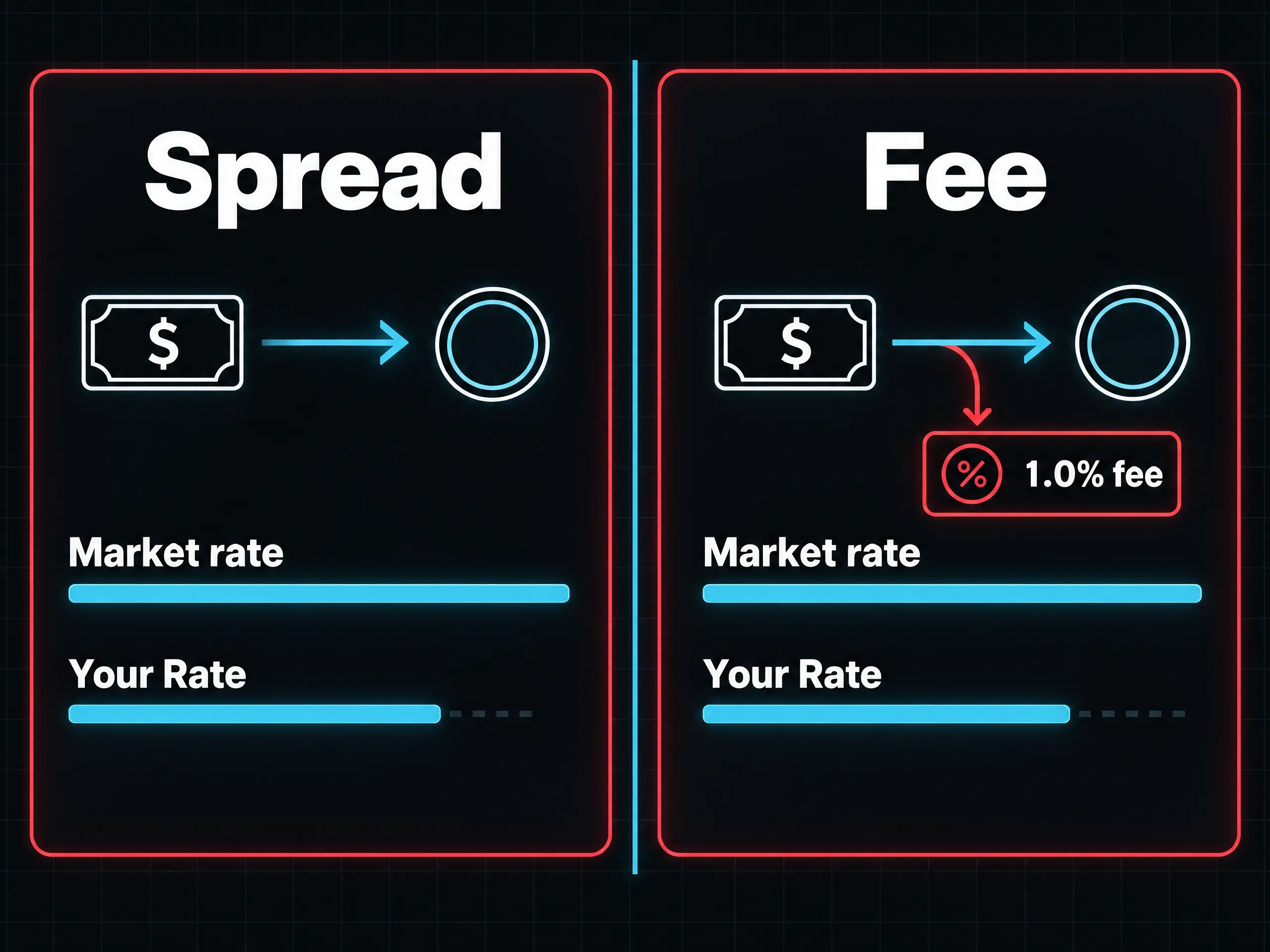
A spread is the gap between the rate you get and the middle market rate.
The middle market rate is the halfway point between the buy and sell prices.
A spread is built into the price. You won't see it as a separate charge. You only see it in the amount you receive.
What is a fee?
A fee is a charge for the service. It can be a fixed amount or a percentage.
Platforms may use different names for it, such as a conversion fee or an adjustment fee. Check what your platform calls it.
A worked example: Costs in both directions
This example uses made-up numbers. The 1% cost is an assumption. It is not a real fee, and it is not a prediction. Trading fees are left out.
You convert 200 USD to USDT. Assume the total cost is 1%.
- Cost: 200 × 1% = 2 USD
- You receive: 200 − 2 = 198 USDT
Now you change your mind and don't trade. You convert back, and the same 1% applies.
- Cost: 198 × 1% = 1.98 USD
- You receive: 198 − 1.98 = 196.02 USD
- Result: 196.02 − 200 = −3.98 USD
You're down 3.98 USD without placing a trade.
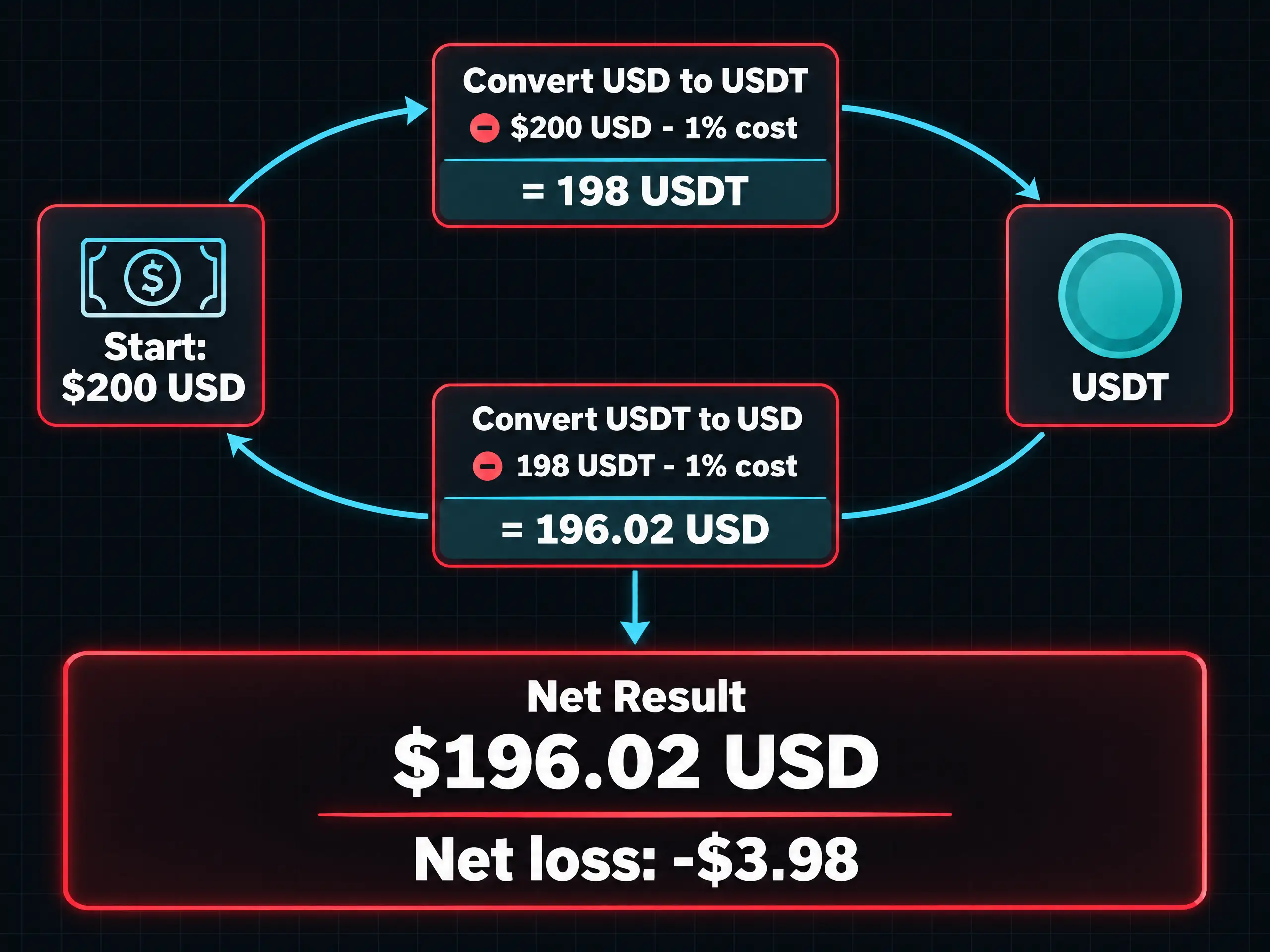
Key takeaway: costs can apply each way. Check them before you move money, not after.
Why small amounts feel the cost more
A flat fee takes a bigger share of a small amount.
Say a flat fee is 2 USD. This is an assumption.
- On 20 USD, that is 2 ÷ 20 = 10%
- On 2,000 USD, that is 2 ÷ 2,000 = 0.1%
So check the real costs before you decide how often to move money.
How to check the cost before you confirm
- Open the summary screen. Find the amount you send and look for any fee or conversion rate.
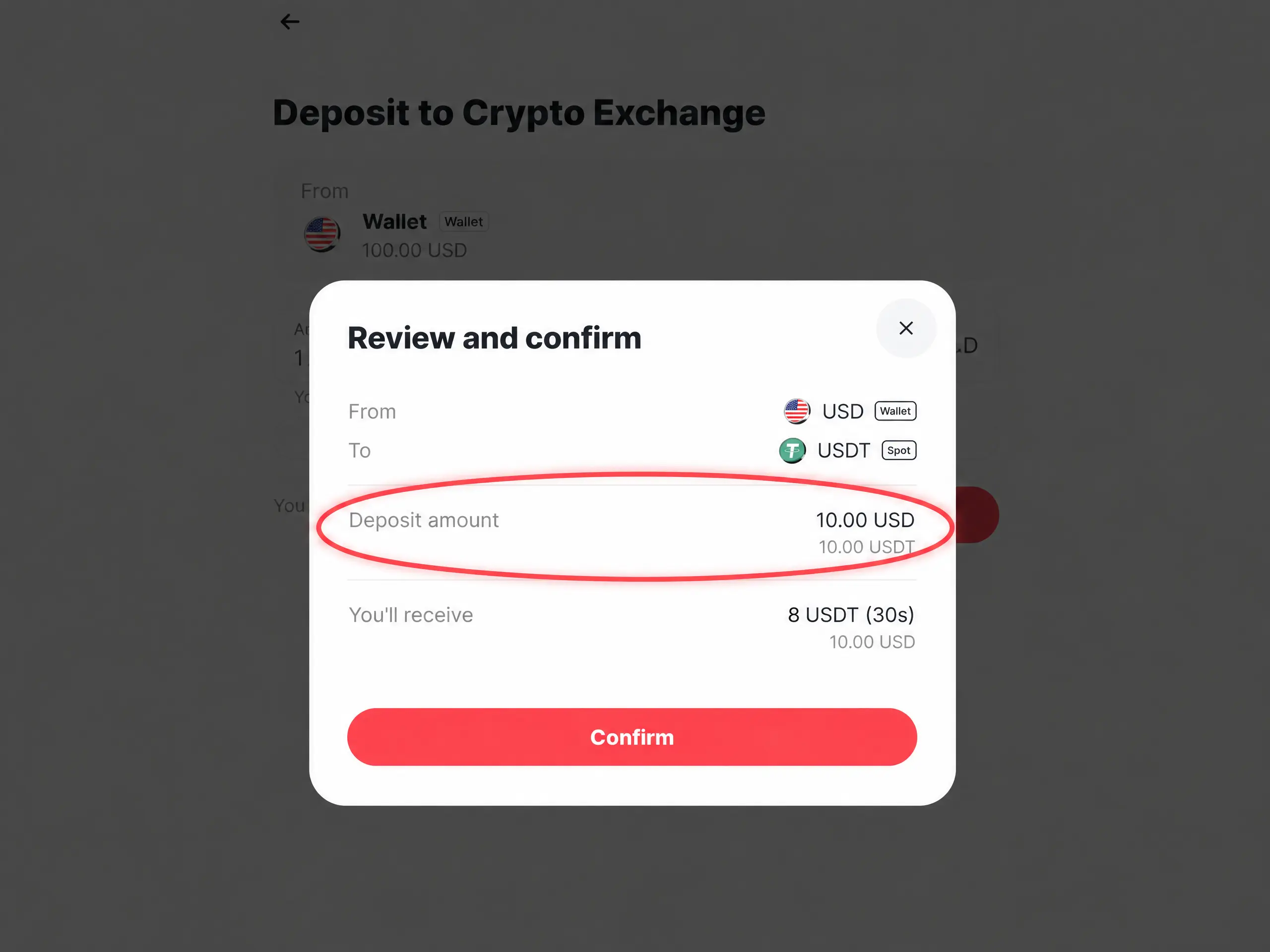
- Check the amount you'll receive. This is the number that matters.
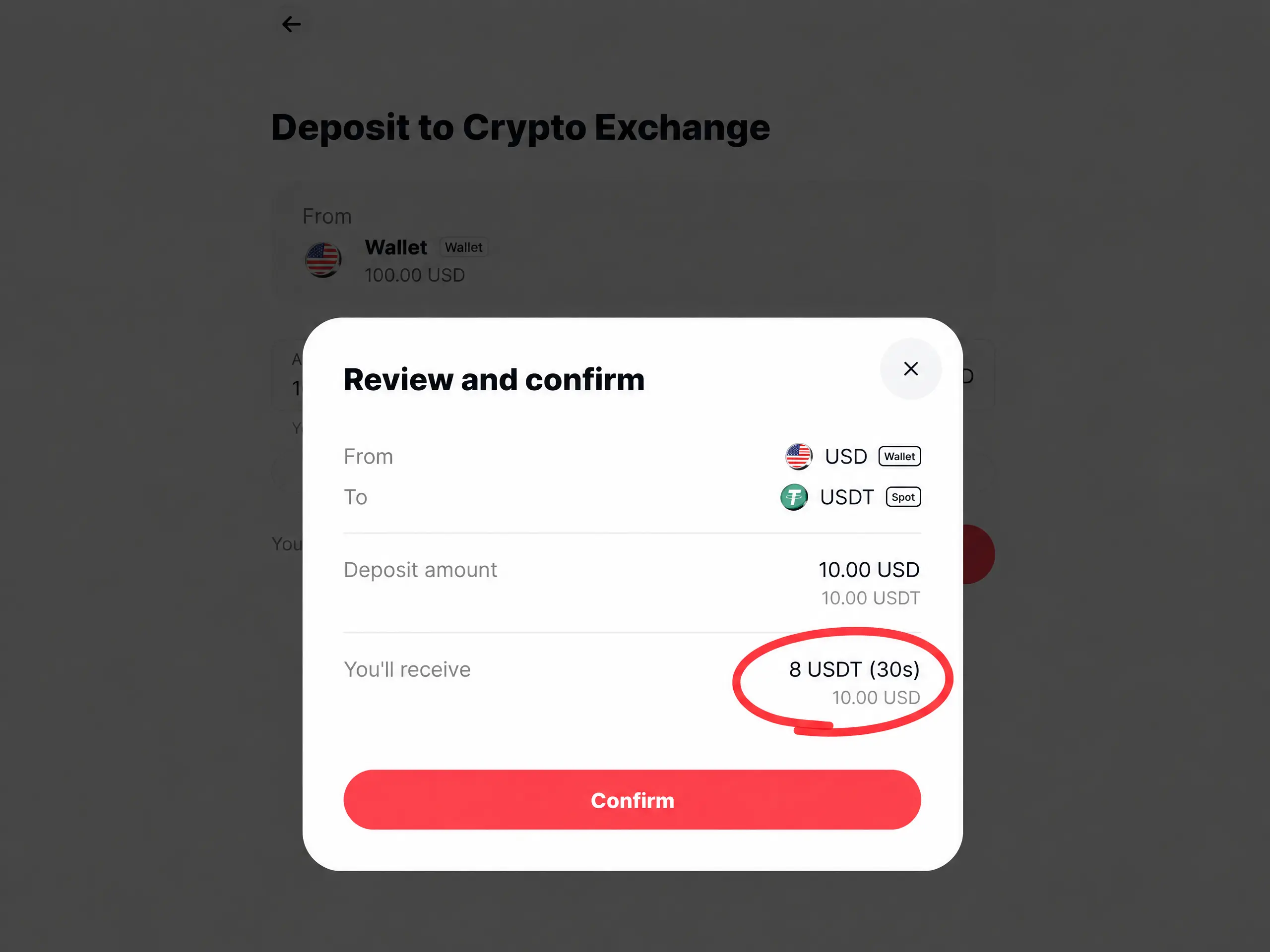
If the amount received is lower than you expected, one of three things may explain it:
- a conversion cost
- a transfer or withdrawal fee
- reading the amount sent as the amount received
What if no conversion applies?
If you move a stablecoin you already hold, no conversion may be needed. You may still pay a transfer fee.
The summary screen shows which case applies to you.
Risk reminder
Transfers and conversions can reduce your balance through fees and rate differences. You can lose some or all of the money you put in. Only use money you can afford to lose. All examples here are hypothetical and are not predictions. This article is for education only and is not financial advice.
Next step
Want to see the way back? Read our guide to how to move funds back to your Wallet.
Quiz
What is a spread?
You convert 200 USD at an assumed 1% cost. How much do you receive?
Why does a flat fee matter more on small amounts?
FAQs


