
High Frequency Volatility (HFV) Indices are Synthetic Indices available exclusively on Deriv that update at two ticks per second; significantly faster than standard Volatility Indices. They operate 24/7 and are unaffected by macroeconomic news or market hours. Because of their continuous, rapid price movement, many traders utilise these indices to execute short-term strategies, such as scalping.
This guide explains how HFV Indices work, what the five index levels mean, why traders frequently adopt short-term approaches when trading them, and the risk management rules that apply to fast-moving markets.
Key takeaways
- High Frequency Volatility (HFV) Indices are Synthetic Indices that offer rapid price feeds, updating at two ticks per second across five distinct volatility levels (10, 25, 50, 75, and 100).
- Their continuous movement makes them a common choice among traders who employ short-term scalping strategies to target small, frequent price moves.
- Traders can access HFV Indices on the Deriv MT5 platform using Standard, Swap-Free, or Zero Spread account types.
- Risk management is non-negotiable: stop-loss orders, correct position sizing, and trading discipline are the three pillars for navigating fast-moving markets.
What is a High Frequency Volatility Index?
An HFV Index is a Synthetic Index that generates price updates at exactly two ticks per second. A tick is a single change in price, so at two ticks per second, the chart is producing 120 price movements per minute, continuously.
Unlike traditional financial markets, which respond to economic data releases, central bank decisions, and geopolitical events, HFV Indices are entirely algorithm-driven. Their volatility is programmed and constant. That means no gap risk from overnight news, no sudden liquidity spikes from an economic data print, and no market closures. The market is always open, always moving, and always at the same structural tempo.
For traders who prefer technical analysis over macroeconomic interpretation, this provides a significant structural advantage.
How do you decode the Deriv high frequency index numbers?
Each HFV Index carries a number—10, 25, 50, 75, or 100—that represents the constant level of simulated volatility applied to that instrument. The number directly indicates how wide the price swings are. Lower numbers produce narrower, more contained movements; higher numbers produce wider, more erratic swings.
- Lower numbers (10 and 25): The High Frequency Vol 10 and 25 indices simulate a market with lower overall volatility. While the price updates at two ticks per second, the actual price swings are generally narrower and less erratic. Beginners typically use these indices to get used to the speed of the high-frequency feed.
- Higher numbers (75 and 100): The High Frequency Vol 75 and 100 indices simulate a highly volatile market. The rapid updates combined with wide price swings mean the market covers significant distance quickly. These indices require a firm grasp of risk control.
All five indices update at two ticks per second. The number changes the amplitude of price movement, not the frequency. Choosing the right index level dictates that a wider-swinging instrument requires a smaller position size to maintain the same monetary risk per trade.
Why do traders often use High Frequency Volatility Indices for scalping?
Scalping is a short-term trading approach where a trader targets small price movements, typically holding positions for seconds to a few minutes. Traders who adopt this approach rely on markets that move frequently and consistently, as slow, thin markets make setups take too long to form and complete.
Traders often use HFV Indices for this exact reason. At two ticks per second, micro-trends and short-term chart patterns form and resolve in a fraction of the time it takes in traditional markets. There is no need to wait for a data release to inject volatility into the market; the movement is constant and algorithmic. This reality allows a trader to execute purely on technical analysis: price action, momentum indicators, and support/resistance levels, without the interference of external market shocks.
However, the reality of trading fast-moving charts is that execution speed and discipline are tested constantly. Because patterns complete quickly, a setup that looks valid one moment can be invalidated in seconds.
How do you trade High Frequency Volatility Indices via CFDs on Deriv?
On Deriv, HFV Indices are traded as Contracts for Difference (CFDs). A CFD allows a trader to speculate on the direction of the index's price without owning the underlying asset.
The mechanics are straightforward:
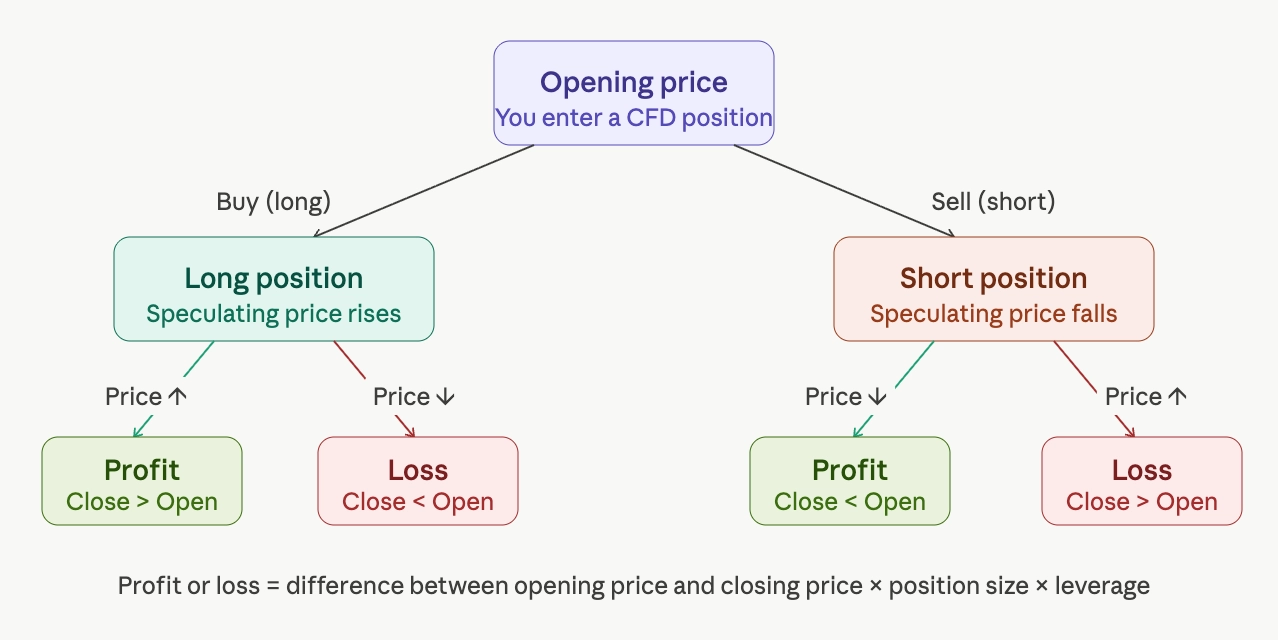
- Buy (long) position: opened when a trader anticipates the index price will rise.
- Sell (short) position: opened when a trader anticipates the index price will fall.
- Profit or loss is determined by the difference between the opening price and the closing price of the contract.
CFDs on these instruments involve leverage. Leverage allows a trader to open a larger position than their deposited margin would otherwise permit. A leverage ratio of 1:100, for example, means a trader controls a position 100 times the size of their margin. This amplifies exposure in both directions; gains and losses are both scaled up relative to the margin used.
Given that HFV Indices can cover significant price distance in a very short time, leverage and position sizing require careful attention. An over-leveraged position on the High Frequency Vol 100 Index can move against a trader quickly. Position size should always be calibrated to account equity and acceptable risk per trade, not to the maximum leverage available.
Which Deriv MT5 account types support High Frequency Volatility Indices
HFV Indices are available on Deriv MT5, across 3 MT5 account types: Standard, Swap-Free, and Zero Spread accounts.
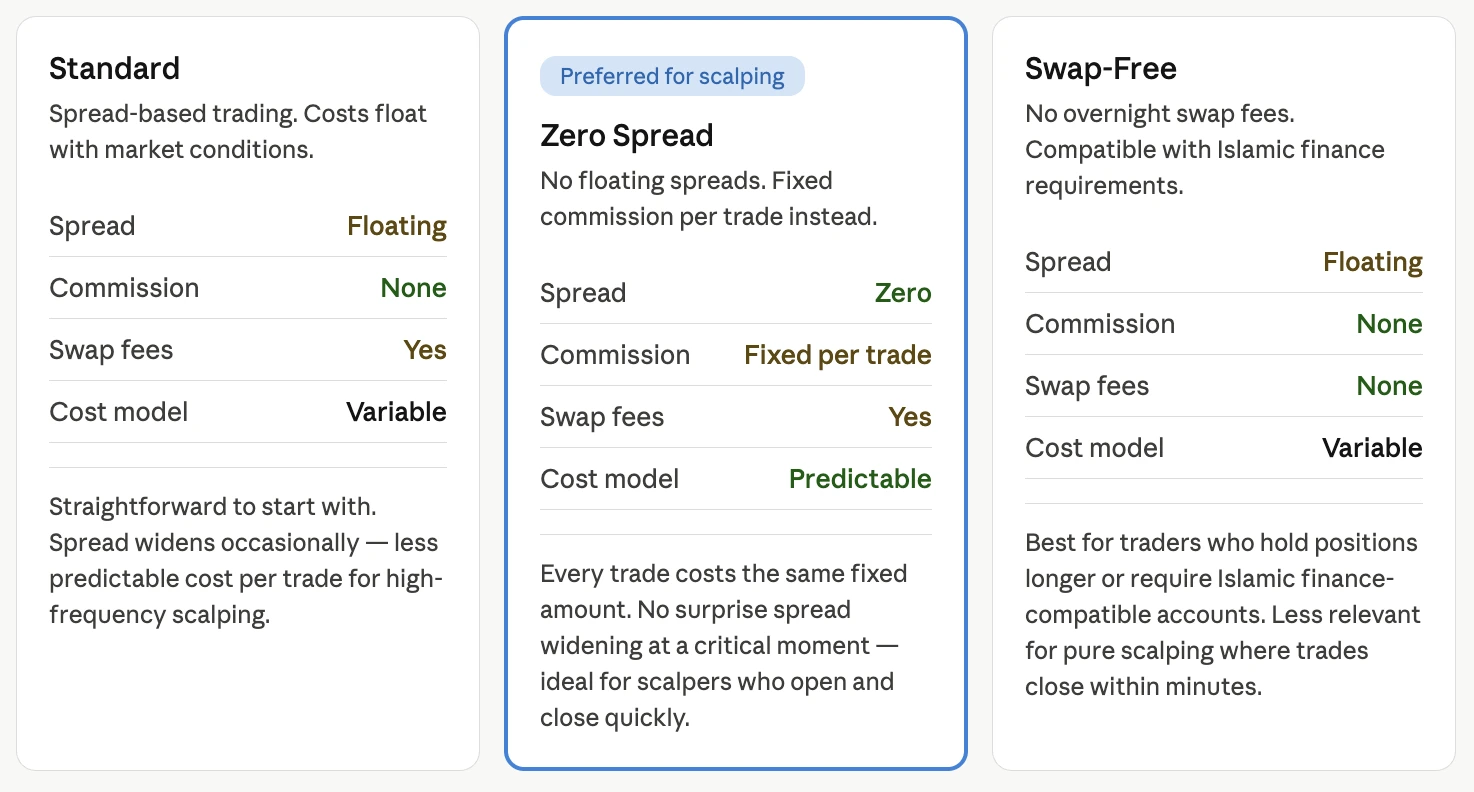
The choice of account type affects the cost structure of trading, not access to the instruments themselves. For pure scalping, where trades are opened and closed within minutes, the Zero Spread account is often preferred because the cost per trade is predictable and there are no floating spreads to widen at the wrong moment.
What risk management rules apply risk management principles to High Frequency Volatility Index trading?
Core risk management for a high frequency market is defined by strict pre-trade planning and execution discipline, primarily because the twice-per-second updates leave no room for hesitation. The three non-negotiable components are: always using a predefined stop-loss order to automatically protect capital; understanding pips and correctly sizing positions relative to account equity (e.g., 1-2% risk per trade); and maintaining emotional discipline so you don't overtrade.
1. Always use a stop-loss order
A stop-loss is an automated instruction given to your trading platform to close your open position if the price moves against you by a specified amount. In HFV trading, a stop-loss is non-negotiable. Because the market can swing rapidly, manually clicking to close a losing trade is often too slow. A predefined stop-loss ensures your idea is invalidated at a specific price point, protecting your capital from larger drawdowns.
2. Size positions relative to account equity
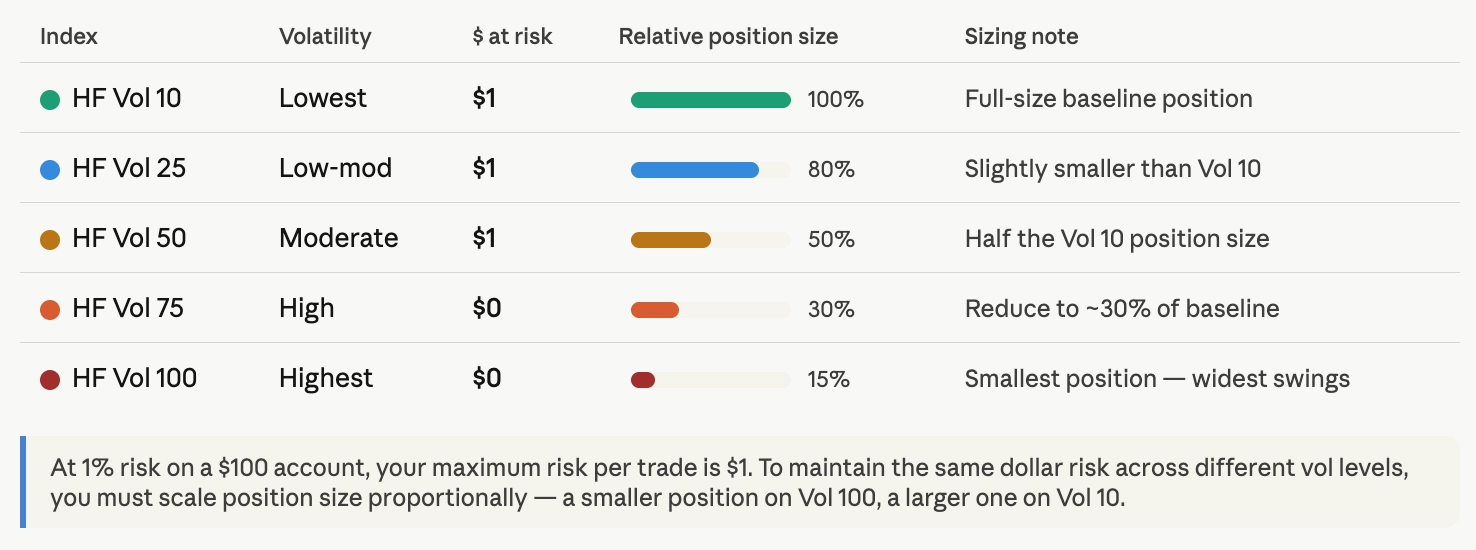
A pip (percentage in point) is the standard unit measuring price movement. The key calculation is: how much capital am I risking per pip of movement? A disciplined approach is to risk a small, fixed percentage of total account equity on any single trade, commonly cited as 1% to 2%.
This calculation must account for the instrument's volatility level. The High Frequency Vol 100 Index has wider price swings than the High Frequency Vol 10 Index. To risk the same monetary amount on both, the position size on Vol 100 must be proportionally smaller.
3. Maintain risk management discipline
Fast markets produce a specific psychological pressure: the urge to enter trades impulsively because something appears to be happening on the chart. This is commonly called overtrading; entering positions without a valid setup because the market looks active.
A structured approach is to complete the trade analysis before the market reaches your level, then wait for the price to arrive at the predefined entry zone. The decision is made in advance. Execution is mechanical. This discipline is what separates consistent traders from those who give back gains by chasing movement.
For further guidance on building structured trading habits, see our online trading tips.
How do you start trading High Frequency Volatility Indices on Deriv?
The recommended entry point for any trader new to these instruments is a Deriv demo account. A demo account provides full access to the Deriv MT5 platform and all five HFV Index levels using virtual funds, so the speed of two ticks per second can be experienced and calibrated against without financial exposure.
The practical steps:
- Open a Deriv demo account (no deposit required).
- Access Deriv MT5 and navigate to Synthetic Indices under the market watch panel.
- Locate the HFV Indices. They will appear as HF Vol 10, 25, 50, 75, and 100.
- Begin with HF Vol 10 or HF Vol 25 to acclimate to the pace of the feed before moving to higher volatility levels.
- Test your entry and exit approach with a defined stop-loss on every trade before moving to a live account.
Summary
HFV Indices offer a unique, fast-paced environment for traders who prefer continuous action and technical analysis. By updating at two ticks per second, they provide an ideal landscape for short-term strategies like scalping. Ranging from the High Frequency Vol 10 Index to the High Frequency Vol 100 Index, they allow traders to select the exact level of market fluctuation they wish to navigate.
However, speed amplifies risk. Success in volatility index trading requires a disciplined approach to position sizing, the mandatory use of stop-loss orders, and a commitment to a predefined trading plan.
If you’re new to this asset class, the best way to become accustomed to the speed of two ticks per second is to practise on a Deriv demo account. This allows you to familiarise yourself with the MT5 platform and test your strategies using virtual funds without risking real capital.
Quiz
FAQs


